Finding the right non-bank lender for your small business in New Jersey starts with understanding your financing options. Whether you need working capital, new equipment, inventory, or funds for expansion, traditional banks are not your only choice.
Non-bank commercial lenders and financing providers offer alternatives to conventional business loans. Depending on the provider, financing may be available through an online direct lender, a business funding marketplace, an SBA-focused lender, or a local funding partner.
For businesses in Newark, Jersey City, Trenton, Camden County, South Jersey, and the Jersey Shore, different financing structures can support different business needs.
Businesses exploring alternative financing can also review available small business loans in New Jersey to better understand their funding options.
This guide compares 10 non-bank lenders and financing providers serving New Jersey, explains their differences, and helps you choose financing based on cost, qualifications, repayment terms, and business cash flow.
Key Takeaways
- Non-bank financing offers alternatives to traditional bank loans. Options include term loans, business lines of credit, equipment financing, invoice factoring, and revenue-based financing.
- Not every financing provider is a direct lender. Some companies arrange financing through banks, private lenders, or funding networks.
- Funding speed and qualification requirements vary. Online financing can be quicker, but approval and timing are never guaranteed.
- Credit scores are not the only consideration. Lenders may also evaluate revenue, cash flow, operating history, existing debt, and collateral.
- New Jersey businesses have local options. Committed to Capital is a small business funding broker based in Pitman, New Jersey. We are not the direct lender on every product.
- The lowest payment is not necessarily the lowest-cost offer. Compare total repayment, financing charges, fees, payment frequency, and contract terms before deciding.
What Are Non-Bank Lenders?
A non-bank lender is a financing company that provides loans or other forms of credit without operating as a traditional deposit-taking bank.
Non-bank business financing is a broader category that also includes companies that arrange financing through lenders or partner financial institutions.
These providers may offer:
- Small business term loans
- Business lines of credit
- Equipment financing
- Revenue-based financing
- Invoice factoring
- Asset-based financing
- Commercial real estate financing
- Other working-capital solutions
Unlike conventional bank underwriting, some non-bank financing programs place additional emphasis on recent business revenue, cash flow, receivables, or available assets.
However, non-bank financing is not automatically easier to qualify for or less expensive. Each provider uses its own eligibility criteria, pricing, and repayment requirements.
Direct Lender vs. Broker vs. Financing Marketplace
Understanding who provides your financing is essential before submitting an application.
| Provider type | How it works | When to consider it |
| Direct lender | Underwrites and originates eligible financing itself | You want to apply to a specific financing source |
| Business loan broker | Helps match businesses with lenders or funding providers | You want guidance comparing financing options |
| Financing marketplace | Connects applicants with multiple potential funding sources | You want to explore more than one lender |
| Financing platform | Provides digital access to financial products, sometimes through partner banks | You prefer online applications and account management |
| SBA-focused lender | Offers eligible government-backed financing programs | You are planning a significant investment and can complete detailed underwriting |
Important: A company described as a non-bank financing provider may offer loans originated by a bank or another financial institution. Always confirm the actual lender named in your agreement.
Non-Bank Lenders for Small Businesses in New Jersey
The following list includes 10 financing providers that New Jersey business owners can consider.
They offer different lending models and product categories. This is a comparison guide, not an independently scored ranking based on rates, approval percentages, or customer satisfaction.
Non-Bank Financing Providers at a Glance
| Provider | Main financing focus | May be suitable for |
| Committed to Capital | Multiple commercial financing products | NJ businesses wanting local guidance |
| OnDeck | Term loans and business lines of credit | Established businesses needing working capital |
| Bluevine | Business lines of credit and partner financing | Businesses wanting digital revolving credit |
| AdvancePoint Capital | Multiple financing products through a marketplace | Owners comparing business funding options |
| Sunrise Funding Group | Working capital and commercial funding | Businesses exploring alternative financing |
| Pursuit Lending | SBA and mission-focused business loans | Planned growth and longer-term investments |
| Rapid Finance | Loans, credit lines, advances, and other financing | Businesses comparing several funding structures |
| National Funding | Business loans and equipment financing | Working capital and equipment purchases |
| FunderFind | Business financing through funding partners | Owners comparing potential financing sources |
| Fora Financial | Working capital, revenue advances, and other financing | Operational needs and business growth |
1. Committed to Capital

Location: Pitman, New Jersey
Primary focus: Multiple business financing solutions
Best fit: Businesses seeking local financing guidance and access to different programs
Committed to Capital helps small and mid-sized businesses explore financing for working capital, growth, equipment, commercial property, and other business needs.
Unlike a provider focused on one lending product, Committed to Capital helps owners evaluate multiple financing structures.
Available financing categories include:
- Business term loans
- Business lines of credit
- Working capital financing
- Equipment financing
- Revenue-based financing
- Invoice factoring
- SBA 7(a) and 504 financing
- Commercial mortgages
- Startup funding options
For example, a South Jersey contractor purchasing machinery may benefit from equipment financing, while a restaurant managing seasonal expenses may need a business line of credit or another working-capital solution.
The appropriate structure depends on eligibility, funding purpose, expected cash flow, and repayment capacity.
Why consider Committed to Capital?
- Based in Pitman, NJ
- Access to multiple financing categories
- Personalized discussions about business funding needs
- Financing solutions for a variety of industries
- Guidance comparing financing structures
May fit businesses that: Prefer working with a New Jersey funding partner instead of selecting a single lending product without guidance.
Explore business financing options.
2. OnDeck
Primary focus: Business term loans and revolving credit
Best fit: Established businesses seeking online financing
OnDeck offers small business term loans and business lines of credit through an online application process.
Its two principal financing products serve different purposes.
A business term loan provides a lump sum that a company repays according to the loan agreement.
A business line of credit provides access to an approved credit limit, allowing eligible businesses to draw funds as needed.
For example, a Newark retailer might consider a term loan for renovations or a revolving line of credit for recurring inventory purchases.
Before choosing a financing product, Newark business owners can learn how small business loans work in Newark, NJ, including common qualification requirements, documentation, and repayment considerations.
Considerations: Review APR, fees, repayment frequency, and any collateral or personal-guarantee requirements. The actual lender may depend on the business and loan.
May fit businesses that: Have an established operating history and want to compare a one-time loan with revolving working capital.
3. BlueVine
Primary focus: Revolving business lines of credit and digital financial services
Best fit: Businesses seeking online access to working capital
BlueVine is a financial technology company offering business banking services and access to commercial financing.
Its line of credit allows qualifying businesses to access funds within an approved limit.
This may be useful for:
- Purchasing inventory
- Managing temporary cash-flow gaps
- Paying operating expenses
- Covering seasonal purchasing needs
- Supporting short-term projects
Lender distinction: Bluevine’s business line of credit is issued by Celtic Bank and serviced by Bluevine. Other financing products may be offered through lending partners.
Business owners should confirm the lender, draw fees, repayment schedule, and credit terms before accepting an offer.
May fit businesses that: Prefer digital financial management and ongoing access to revolving business credit.
4. Advancepoint Capital
Primary focus: Business funding marketplace
Best fit: Owners exploring multiple financing products
AdvancePoint Capital is a commercial financing provider that helps businesses explore financing through funding sources and partner programs.
The company’s listed financing categories include business loans, lines of credit, SBA financing, equipment financing, invoice factoring, and other working-capital products.
This marketplace approach can be useful when a business owner is unsure which financing structure fits a particular expense.
For example, a manufacturer considering a large equipment purchase may want to compare equipment financing with a term loan rather than automatically choosing general-purpose working capital.
Considerations: Confirm the funding provider behind each offer, any intermediary compensation, and the full financing agreement.
May fit businesses that: Want to consider multiple financing products through a funding marketplace.
5. Sunrise Funding Group

Primary focus: Working capital and commercial financing
Best fit: Businesses exploring alternative funding options
Sunrise Funding Group is included among the business financing providers serving companies seeking working capital and other commercial funding solutions.
The financing categories identified in this guide include:
- Working capital
- Business lines of credit
- Equipment financing
- Business growth funding
These categories can address different needs.
A business line of credit may help with recurring operating expenses, while equipment financing can be more appropriate for a defined asset purchase.
Considerations: Before applying, verify the provider’s current programs, lender relationships, application requirements, and fees.
May fit businesses that: Want to investigate working-capital or equipment-related financing through a funding service.
6. Pursuit Lending
Primary focus: SBA and mission-focused small business financing
Best fit: Businesses planning longer-term investments
Pursuit Lending serves small businesses in New Jersey and other states through financing and business-support programs.
Pursuit offers financing options that include SBA-backed lending and other small business programs.
Depending on eligibility and the program, possible uses include:
- Business expansion
- Equipment purchases
- Working capital
- Business acquisition
- Eligible commercial real estate
- Certain refinancing needs
Unlike short-term online funding, SBA financing commonly involves more detailed documentation and underwriting.
However, qualifying businesses may find a longer repayment structure more appropriate for major investments.
May fit businesses that: Have time to complete a detailed financing application and want to evaluate SBA or community-oriented lending.
7. Rapid Finance
Primary focus: Multiple commercial financing structures
Best fit: Businesses comparing funding for different operational needs
Rapid Finance provides and arranges several types of small business financing.
Its available financing categories include:
- Small business loans
- Business lines of credit
- Merchant cash advances
- Bridge financing
- SBA financing
- Invoice factoring
- Asset-based financing
These products should not be treated as interchangeable.
For example, a term loan with scheduled payments can affect cash flow differently from a merchant cash advance tied to receivables.
A merchant cash advance is generally a purchase of future receivables rather than a conventional business loan, although the exact legal and contractual treatment depends on the arrangement.
Considerations: Carefully compare payment frequency, total cost, the financing provider, and any refinancing or renewal provisions.
May fit businesses that: Want to explore several commercial financing structures for operating expenses or growth.
8. National Funding

Primary focus: Business loans and equipment financing
Best fit: Businesses purchasing equipment or seeking working capital
National Funding provides business financing products that include working-capital funding and equipment financing.
Its equipment programs may be relevant to companies purchasing:
- Construction equipment
- Commercial vehicles
- Manufacturing machinery
- Business technology
- Other qualifying equipment
Equipment financing can help a business spread the cost of an eligible purchase rather than using its available cash reserves all at once.
For example, a New Jersey construction contractor may compare equipment financing for a truck or excavator with a business term loan used for a broader project.
Considerations: Review whether the agreement is a loan or lease, the repayment schedule, ownership terms, collateral conditions, and total financing cost.
May fit businesses that: Need funding for a specific equipment purchase or a general working-capital expense.
9. Funderfind

Primary focus: Business funding service and financing partner network
Best fit: Owners exploring multiple commercial funding sources
FunderFind is listed as a business financing service that helps companies explore financing through funding partners.
The categories identified in this guide include:
- Business term loans
- Business lines of credit
- Working capital
- Equipment financing
- SBA financing
- Asset-based financing
- Merchant cash advances
For business owners considering several types of financing, a funding service can provide another starting point for comparing options.
However, comparing offers requires more than reviewing the amount available.
Considerations: Verify the company’s current operating information, identify the actual lender, and compare all fees and repayment obligations before proceeding.
May fit businesses that: Want to explore different funding categories through a financing intermediary.
10. Fora Financial

Primary focus: Working capital and business financing
Best fit: Businesses financing operating expenses and near-term growth
Fora Financial provides access to small business funding products, including business financing and revenue advances.
Its financing offerings and partner options include business term loans, lines of credit, equipment financing, and SBA-related products.
Possible business uses include:
- Inventory purchases
- Staffing
- Marketing
- Renovations
- Working capital
- Expansion expenses
Business owners should distinguish between a traditional loan and a revenue advance because repayment calculations and contractual obligations differ.
Considerations: Review the total repayment amount, payment schedule, fees, personal-guarantee provisions, and whether the repayment amount changes with revenue.
May fit businesses that: Need commercial financing for short-term operations or business growth.
Non-Bank Financing Options in New Jersey at a Glance
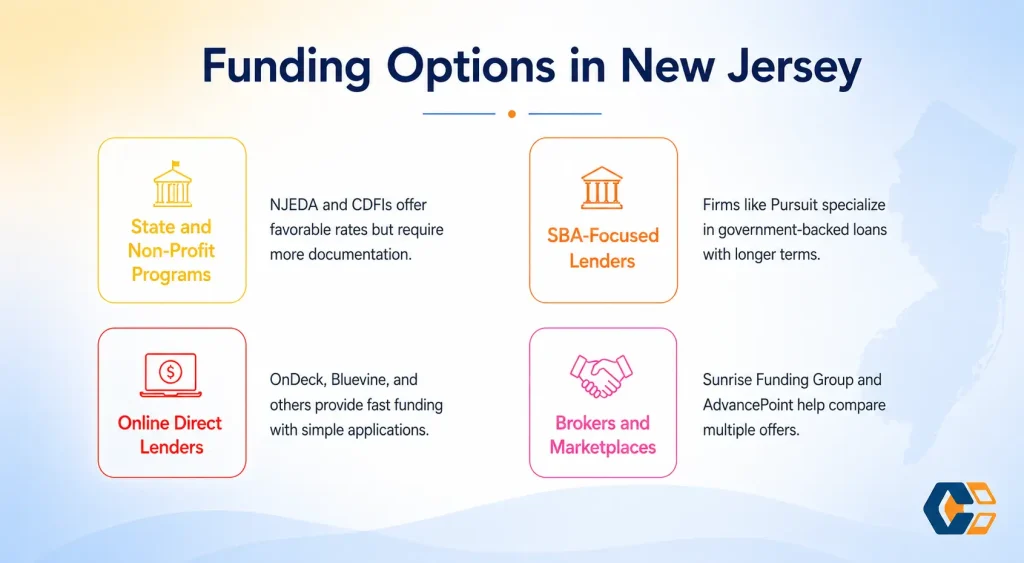
Non-bank financing covers several products, each designed for a different funding purpose.
| Financing option | Common business use | Main consideration |
| Business term loan | Planned investments, renovations, and expansion | Repayment schedule and total borrowing cost |
| Business line of credit | Recurring expenses, inventory, temporary cash-flow gaps | Draw costs, credit availability, and repayment rules |
| Equipment financing | Machinery, vehicles, technology, and tools | Asset eligibility, term, and ownership |
| Revenue-based financing | Businesses with qualifying revenue streams | Remittance method and total financing cost |
| Invoice factoring | B2B companies with unpaid customer invoices | Factoring fees, customer payments, and recourse |
| SBA financing | Eligible long-term investments and working capital | Documentation, eligibility, and processing |
| Asset-based financing | Businesses with eligible collateral | Asset valuation and security interests |
| Commercial mortgage | Purchasing or refinancing commercial property | Property eligibility, collateral, and loan terms |
Which Financing Option Should Your Business Consider?
If you need recurring working capital: Consider a business line of credit.
If you need machinery, vehicles, or technology: Explore equipment financing.
If your customers pay invoices slowly: Review invoice factoring.
If you are planning a larger investment: Consider SBA 7(a) and 504 financing, subject to eligibility.
If your business revenue fluctuates: Explore revenue-based financing, while checking how repayment is calculated.
The right financing category depends on your business goals, existing obligations, and ability to repay not simply the size of the available offer.
Can New Jersey Businesses Get Revolving Credit Without a Traditional Bank?
Yes. Some online financing providers and non-bank funding networks offer access to business lines of credit, although certain products are originated by partner banks.
A revolving business line of credit allows an eligible company to borrow within an approved credit limit, repay outstanding balances, and potentially access available credit again.
This can be useful for businesses with recurring short-term funding requirements.
Revolving Credit for Distributors and Wholesalers
A New Jersey distributor may need to purchase inventory before collecting payment from customers.
For example, consider a wholesale company that receives a large customer order but must pay suppliers before the customer pays its invoice.
Depending on eligibility and the transaction, the business might compare:
- Business line of credit: Provides reusable capital for inventory and operating expenses.
- Invoice factoring: May help release cash tied up in qualifying unpaid B2B invoices.
- Purchase-order financing: May help finance eligible supplier costs for a confirmed customer order.
- Term loan: Provides a lump sum for an investment with a defined repayment schedule.
Business owners can explore practical ways to use a business line of credit for inventory purchases, payroll timing, short-term cash-flow gaps, and other operating needs.
Community banks may also offer revolving business credit. The best choice depends on cost, financial qualifications, borrowing needs, and the company’s operating cycle.
If your business regularly finances inventory, a revolving line may be more suitable than repeatedly applying for separate short-term loans.
Non-Bank Commercial Real Estate Financing in New Jersey
Businesses purchasing, refinancing, or improving commercial property may also consider non-bank commercial mortgage lenders.
Commercial real estate financing is different from a general working-capital loan because underwriting may depend heavily on the property, the borrowing business, and the proposed transaction.
Common financing purposes include:
- Purchasing owner-occupied business property
- Refinancing an existing commercial mortgage
- Financing eligible property improvements
- Acquiring investment property through qualifying commercial loan programs
- Funding certain commercial construction or expansion projects
Commercial Mortgage vs. SBA Real Estate Financing
A commercial mortgage may be structured for a broader range of eligible real estate transactions.
SBA 504 financing is commonly considered for qualifying owner-occupied commercial real estate and major fixed-asset investments. SBA 7(a) loans may also finance certain eligible real estate transactions.
SBA programs have specific eligibility and permitted-use requirements and should not be assumed to cover ordinary investment property purchases.
For New Jersey business owners, choosing between these financing structures depends on property use, available equity, collateral, repayment capacity, and qualification.
Learn more about commercial mortgage financing.
New Jersey Invoice Factoring Companies and Accounts Receivable Financing
For businesses that sell goods or services to other businesses, unpaid invoices can create working-capital pressure even when sales are strong.
Invoice factoring involves selling eligible accounts receivable to a factoring company in exchange for earlier access to a portion of their value.
For example, a New Jersey transportation company may complete deliveries for a commercial customer but wait several weeks for payment.
Rather than waiting for the invoice due date, the company may consider factoring eligible invoices to support near-term operating expenses.
When Invoice Factoring May Make Sense
Invoice factoring may be relevant when:
- Your company sells primarily to business customers.
- You issue invoices with payment terms.
- Customers have not yet paid qualifying invoices.
- Delayed collections are affecting working capital.
- You want financing tied to receivables rather than a general-purpose loan.
Factoring is not the same as a traditional term loan.
Business owners should review advance rates, factoring fees, customer notification requirements, recourse provisions, and collection arrangements.
Learn how accounts receivable financing and factoring work.
Restaurant, Retail, and Seasonal Working Capital Along the Jersey Shore
New Jersey’s seasonal businesses often face a timing challenge: expenses arrive before the revenue needed to cover them.
Restaurants, hospitality businesses, retailers, and seasonal service providers in areas such as Cape May, Wildwood, Point Pleasant, and Atlantic City may experience significant changes in customer demand throughout the year.
That makes repayment planning especially important.
Match Financing to the Business Expense
A restaurant renovating an outdoor dining area before summer has a different funding requirement from a retailer purchasing seasonal inventory.
Potential financing structures include:
- Term loans: For a defined project or planned investment.
- Equipment financing: For commercial kitchen equipment, vehicles, or other eligible assets.
- Business lines of credit: For recurring inventory purchases or temporary cash-flow needs.
- Revenue-based financing: For eligible businesses exploring repayment arrangements linked to revenue.
Retail owners preparing for seasonal demand can also review this guide to working capital for small retail businesses to understand inventory financing, liquidity, and operating cash-flow needs.
A financing product should be selected based on its terms and suitability, not an assumption that all seasonal financing adjusts automatically when sales decline.
Prepare for Both Peak and Off-Season Payments
A Jersey Shore business may generate strong revenue during summer and significantly less during winter.
Before accepting funding, owners should estimate how repayments will affect cash flow in both periods.
For example, a payment schedule that is manageable during peak season may create problems when customer traffic declines.
When reviewing offers, ask:
- Can the business afford payments during its slowest months?
- Are payments fixed or linked to revenue?
- How often will payments be collected?
- Will borrowing reduce the cash needed for payroll, inventory, or rent?
- What happens if revenue falls below expectations?
Business owners can prepare for changing demand through seasonal planning with working capital, including forecasting expenses, building cash reserves, and identifying financing needs before peak season begins.
For seasonal operations, the right repayment structure can be just as important as the available funding amount.
Read more about seasonal restaurant cash flow and retail holiday inventory financing.
Why New Jersey Businesses Choose Non-Bank Lenders
New Jersey small businesses may consider non-bank commercial lenders when they want alternative underwriting, access to specialized financing, or a more streamlined application process.
Faster and More Convenient Applications
Many non-bank lenders offer digital applications and electronic document submission.
This can simplify the process for owners managing daily operations. However, actual approval and funding timelines depend on underwriting and the financing product.
Different Credit and Cash-Flow Requirements
Some alternative business lenders evaluate business revenue, operating history, cash flow, and bank activity alongside credit history.
A lower credit score does not automatically prevent approval, but it can affect eligibility and financing terms.
More Specialized Financing Options
Businesses can compare products designed for equipment, receivables, commercial real estate, inventory, or broader working-capital requirements.
A specialized financing product may align more closely with a specific expense than a general-purpose loan.
Access to Funding Partners and Marketplaces
Brokers and marketplaces may help business owners investigate several commercial financing routes.
However, an intermediary may not provide financing directly. Borrowers should confirm the source of funds and understand any applicable fees.
Flexible Ways to Support Business Growth
Non-bank financing can help eligible businesses purchase equipment, manage cash-flow gaps, finance inventory, or support expansion.
When might a bank or SBA loan be better?
Businesses with strong financial qualifications, sufficient time for underwriting, and longer-term investment plans should compare traditional bank and SBA financing too.
Non-bank funding is an additional option—not automatically the cheapest or best option.
How to Choose the Right Non-Bank Lender in NJ
Choosing a business financing provider is easier when you compare the same information across different offers.
Step 1: Identify Your Funding Purpose
Start with the specific business expense.
Are you purchasing equipment, managing payroll, financing inventory, renovating a property, or preparing for a new contract?
A clear purpose helps narrow the financing products worth considering.
Step 2: Review Your Business Qualifications
Before applying, gather relevant information about your business.
Documents may include:
- Recent business bank statements
- Business revenue and financial statements
- Business tax returns, when requested
- Current loan and debt information
- Ownership and identification documents
- Details of the intended use of funds
- Information about available collateral, when applicable
Qualification criteria vary by lender. There is no single credit-score, revenue, or time-in-business requirement that applies to every non-bank financing program.
If your business credit profile needs attention, review these practical steps to improve your business credit score before applying for financing.
Step 3: Select the Appropriate Financing Type
Match the financing product to the expense.
A business line of credit may suit recurring short-term needs, while equipment financing may better match an asset purchase.
For larger eligible investments, compare SBA or commercial real estate financing.
If you are considering lump-sum funding, understanding how to qualify for a business term loan in New Jersey can help you prepare the required financial information and evaluate lender expectations.
Step 4: Compare the Full Cost of Financing
Before signing, request a clear explanation of:
- Net funds the business will receive
- Total repayment obligation
- Interest or financing charges
- APR, when applicable and available
- Origination or intermediary fees
- Repayment frequency and duration
- Prepayment provisions
- Collateral or lien requirements
- Personal-guarantee obligations
- Late-payment and renewal terms
Do not confuse a factor rate with an APR.
For example, a financing offer using a factor rate of 1.30 on $50,000 indicates a total repayment obligation of $65,000 before any additional charges.
That represents $15,000 above the amount financed, but it does not establish an annual percentage rate. An APR comparison requires more information about the repayment timeline, payment structure, and applicable fees.
Step 5: Verify the Financing Provider
Confirm who will actually provide the financing.
Review the business’s legal information, customer-facing disclosures, relevant licensing requirements, contact details, and contract terms.
Be cautious of providers that:
- Refuse to explain total repayment
- Pressure you to sign before reviewing terms
- Cannot identify the lender
- Provide vague answers about fees
- Encourage unnecessary additional borrowing
- Do not clearly explain repayment obligations
A financing agreement should be understandable before you commit.
Why Small and Mid-Sized Businesses Choose Committed to Capital
Committed to Capital is based in Pitman, New Jersey, and helps small and mid-sized businesses explore financing for a variety of commercial needs.
Rather than offering every business the same financing structure, our approach begins with understanding the use of funds, business performance, and repayment needs.
Local New Jersey Financing Guidance
Business financing needs vary across the state.
A logistics company near Port Newark may need working capital to fulfill a new contract.
A Trenton manufacturer may be purchasing machinery.
A Camden County contractor may need equipment or vehicles.
A Jersey Shore retailer may be purchasing inventory before its busiest season.
Each business requires a different financing assessment.
Multiple Funding Categories
We help business owners explore financing options across working capital, equipment, commercial real estate, and business growth.
This gives eligible businesses an opportunity to consider different financing structures before choosing a funding route.
Personalized Funding Discussions
Business owners can discuss their capital needs with a funding professional rather than relying entirely on an automated product selection process.
The goal is to understand the options available and how each may affect the business.
Types of Business Funding We Offer
Committed to Capital helps businesses explore a range of financing options.
| Funding type | Common business purpose |
| Equipment financing | Machinery, vehicles, technology, and specialized equipment |
| Business term loans | Expansion, inventory, renovations, and other defined investments |
| Business lines of credit | Recurring working capital, seasonal needs, and short-term expenses |
| Revenue-based financing | Eligible companies considering revenue-linked repayment |
| SBA 7(a) and 504 financing | Qualifying business acquisitions, fixed assets, expansion, and permitted working capital |
| Invoice factoring | Eligible B2B accounts receivable |
| Startup funding | Financing routes for newer businesses, subject to program criteria |
| Commercial mortgages | Eligible business property purchases and refinancing |
Product availability and financing terms depend on the funding provider and the applicant’s qualifications.
Explore Business Financing Options in New Jersey
Choosing a non-bank lender should begin with your business’s needs—not simply the promise of fast funding.
Whether you need working capital in South Jersey, a business line of credit, commercial property financing, or funds for equipment and inventory, comparing available financing structures can help you make a more informed decision.
Committed to Capital works with businesses throughout New Jersey, including North Jersey, Central Jersey, South Jersey, and the Jersey Shore.
Ready to discuss your financing needs?
Explore our business financing options or contact Committed to Capital to discuss possible funding solutions for your business.