Retail holiday inventory financing helps physical store owners cover the cost of seasonal merchandise before customer sales generate enough cash to pay for it. Options may include business lines of credit, short-term loans, inventory-backed financing, and supplier credit, depending on eligibility and the store’s cash flow.
For many independent stores, holiday preparations begin months before the busiest shopping weeks. Gift shops, apparel retailers, toy stores, hardware stores, and specialty shops often need to place orders and pay supplier deposits well in advance.
Key Takeaways
- Holiday inventory often must be ordered and paid for before the busiest selling weeks, creating a seasonal cash gap for physical retail stores.
- The National Retail Federation (NRF) defines the winter holiday season as November 1 through December 31. Holiday sales have averaged approximately 19% of annual retail sales over the past five years.
- Calculate your inventory funding needs using expected sales, inventory costs, available stock, vendor payment terms, and operating cash reserves.
- Business lines of credit, short-term loans, inventory financing, and supplier payment terms may help retailers prepare for seasonal demand.
- Plan repayment beyond December to account for January returns, markdowns, slower foot traffic, and ongoing operating costs.
Understanding the available retail store business loans can help owners compare financing structures while planning seasonal inventory purchases.
This guide explains how to estimate holiday inventory needs, compare financing options, and plan repayment without putting unnecessary pressure on cash flow after the holiday season.
Why Holiday Inventory Puts Pressure on Store Cash Flow
Retail businesses often pay suppliers before customers purchase their products. This creates a gap between cash going out for merchandise and revenue coming in from sales.
During the holiday season, that gap can become more significant because stores may order larger quantities and increase staffing before peak demand arrives.
Three factors make holiday inventory planning especially important.
- Concentrated holiday demand. According to NRF, November and December holiday sales have averaged approximately 19% of annual retail sales over the past five years. Individual retailers may experience a substantially higher seasonal share.
- Earlier shopping activity. NRF reports that at least two in five holiday shoppers have started browsing and purchasing before November for more than a decade.
- Post-holiday sales declines. U.S. Census Bureau data shows that unadjusted total U.S. retail sales increased 5.4% from Q3 to Q4 2025 before declining 9.7% in Q1 2026. These are national figures, not forecasts for individual stores.
For retail owners, the challenge is straightforward: inventory payments, rent, payroll, and supplier obligations may come due before sufficient holiday revenue is collected.
Sources: NRF Winter Holiday FAQs and U.S. Census Bureau Quarterly Retail Sales.
The Holiday Buying Calendar for Physical Stores
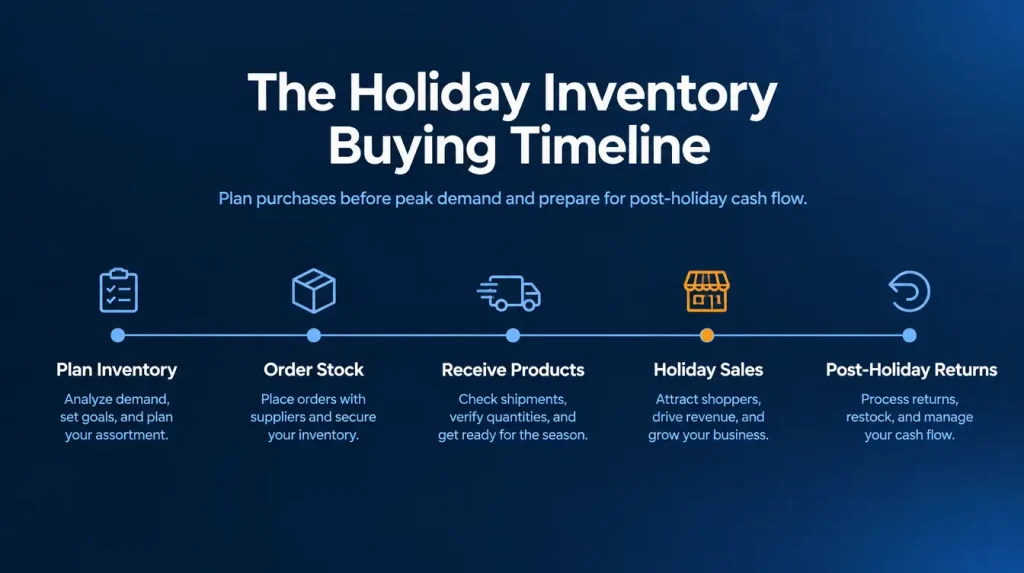
Every retailer has different vendor lead times and seasonal demand patterns. However, most holiday inventory cycles follow a similar sequence.
| Stage | What Happens | Cash Flow Impact |
| Planning | Review previous holiday sales and estimate inventory demand | Limited immediate outflow |
| Ordering | Place supplier orders and confirm delivery schedules | Deposits may be required |
| Receiving | Receive merchandise and pay applicable balances and freight charges | Significant cash outflow |
| Merchandising | Prepare displays and schedule seasonal employees | Payroll and operating costs increase |
| Early season | Begin selling merchandise ahead of November | Initial sales help replenish cash |
| Peak season | Capture November and December shopping demand | Higher sales may improve cash flow |
| Post-holiday | Process returns, exchanges, and markdowns | Cash flow may tighten |
The most important planning date is not necessarily Black Friday or Christmas.
It is the point when the greatest amount of cash is committed to inventory and the least amount has returned through customer sales.
Identifying that period helps determine when financing may be needed.
How Much Holiday Inventory Financing Do You Need?
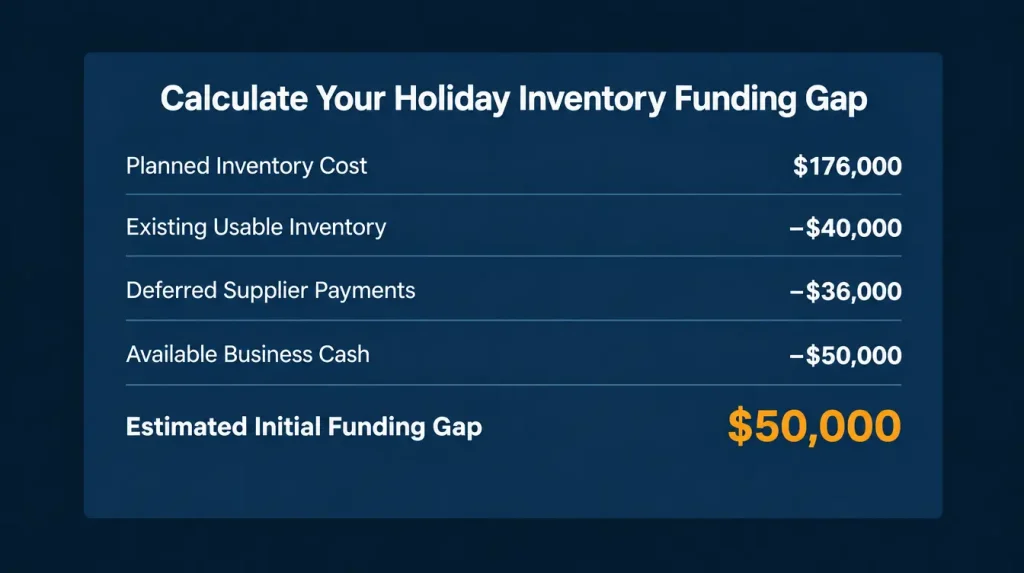
The amount of holiday inventory financing a store needs depends on its expected sales, merchandise costs, existing inventory, supplier terms, and available cash.
Start with these five steps.
- Estimate holiday sales. Review previous November and December sales by product category and adjust for realistic demand changes.
- Calculate merchandise costs. Apply your expected cost of goods sold percentage to projected holiday sales.
- Subtract usable inventory. Include merchandise already available that you realistically expect to sell during the season.
- Account for supplier payment terms. Identify which supplier payments can be deferred until after customer sales begin.
- Subtract available operating cash. Only include cash that can be committed without compromising payroll, rent, and essential business expenses.
The result is a preliminary funding estimate.
Simplified formula:
Holiday inventory funding gap = Planned inventory purchases at cost – Usable existing inventory at cost – Supplier payments deferred beyond the funding period – Available cash allocated to inventory.
This calculation estimates the immediate inventory funding need. It does not replace a weekly cash flow forecast, and supplier payments deferred until later still need to be paid.
Worked Example: A Gift Shop Plans Its Holiday Inventory
The following example is hypothetical and provided for educational purposes.
A two-location gift shop generated $300,000 in sales during the previous November and December. The owner expects holiday sales to reach $320,000 this year.
| Calculation | Amount |
| Projected holiday sales | $320,000 |
| Planned merchandise cost at 55% | $176,000 |
| Less usable inventory already available | ($40,000) |
| Less supplier payments deferred beyond the initial funding period | ($36,000) |
| Less available cash allocated to inventory | ($50,000) |
| Estimated initial funding gap | $50,000 |
The owner identifies late September as the likely period of greatest cash pressure, when seasonal merchandise is arriving but customer sales remain limited.
The calculation suggests an initial $50,000 inventory funding need.
However, the owner should also model the additional cash required when the $36,000 in deferred supplier payments becomes due, along with financing payments and normal operating expenses.
A weekly cash flow forecast can help determine whether the store can afford the proposed financing structure through January and February.
For broader financial planning, read our working capital guide for small retail businesses.
Financing Options for Holiday Inventory
Several financing structures may help retailers purchase seasonal merchandise. The appropriate option depends on the timing of supplier payments, how quickly inventory is expected to sell, business qualifications, and financing costs.
Business Line of Credit
A business line of credit gives eligible businesses access to an approved borrowing limit.
Retailers can draw funds when needed and restore available credit as they repay, subject to their agreement.
This structure may be useful for recurring seasonal inventory purchases because the business does not necessarily need to borrow the full approved amount at once.
Interest is generally charged on borrowed amounts, although some agreements may include additional fees or minimum charges.
Best suited for: Retailers with recurring inventory purchases and predictable seasonal cash flow patterns.
Short-Term Business Loan
A short-term business loan provides a lump sum that is repaid according to the financing agreement.
This may be appropriate when a retailer has a defined inventory purchase, such as stocking a new location or placing a large seasonal order.
Before accepting an offer, compare repayment frequency, fees, total borrowing costs, and the store’s projected cash flow.
Our term loans page explains fixed-schedule business financing.
Best suited for: Clearly defined, one-time purchases with a realistic repayment plan.
Inventory Financing and Purchase Order Financing
Inventory financing may allow qualified businesses to borrow against eligible merchandise or use inventory as collateral.
Purchase order financing is a different structure. It generally helps eligible businesses fulfill confirmed customer purchase orders by paying suppliers, rather than simply financing anticipated walk-in consumer demand.
Because most physical retailers purchase inventory before receiving customer orders, purchase order financing may not suit every storefront.
Our purchase order financing guide explains where that financing structure may apply.
Best suited for: Eligible inventory-backed transactions or businesses with qualifying purchase orders.
Revenue-Based Financing
Revenue-based financing may provide funding based partly on a business’s revenue performance.
Some agreements use a percentage of eligible sales for remittances. Under those structures, payments may fluctuate with sales.
Other agreements require fixed daily or weekly payments, even when revenue declines.
Retailers should review the specific contract, understand any reconciliation provisions, and calculate the total financing cost before accepting an offer.
Best suited for: Businesses whose revenue patterns and available cash flow support the actual remittance structure.
Vendor Payment Terms
Before using external financing, ask suppliers whether they offer extended payment terms, staggered deposits, or seasonal payment arrangements.
These options may reduce the amount of outside capital needed during the inventory purchasing period.
However, supplier financing can involve pricing differences, payment deadlines, or other conditions that should be evaluated.
Best suited for: Retailers with established supplier relationships and flexible purchasing agreements.
How Should Retail Stores Plan Holiday Inventory Repayment?
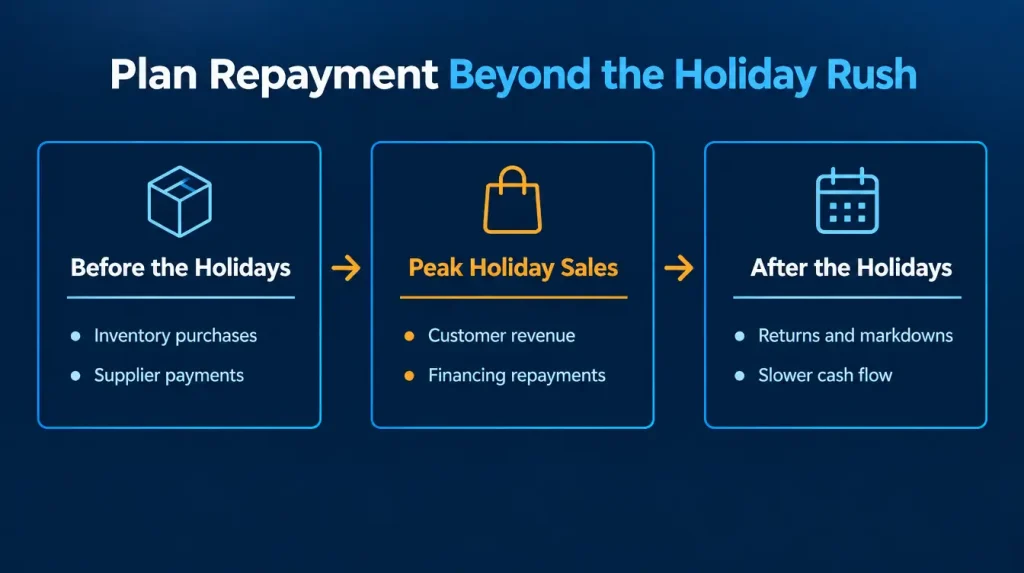
Retail stores should plan repayment around the complete inventory selling cycle, including the slower weeks after December, rather than assuming peak holiday sales will cover every financing obligation.
Consider the following.
- Match financing to inventory turnover. Compare expected merchandise sell-through dates with the payment schedule.
- Review payment frequency. Determine how daily, weekly, or monthly payments affect available cash.
- Allow for returns. NRF and Happy Returns reported that retailers expected approximately 17% of 2025 holiday sales to be returned.
- Prepare for slower January revenue. Keep enough cash available for rent, payroll, supplier balances, and other obligations.
- Compare total costs. Request written details covering the amount received, total repayment, fees, payment frequency, and any prepayment or reconciliation conditions.
A financing option that appears affordable during December may become difficult to manage when customer traffic slows.
Source: NRF 2025 Retail Returns Report.
Holiday Inventory Financing Risks to Watch
Inventory financing can support seasonal purchasing, but borrowing also creates financial obligations.
Overbuying Seasonal Merchandise
Excess inventory may need to be discounted after the holidays, reducing margins and delaying cash recovery.
Late Supplier Deliveries
Merchandise arriving after peak shopping periods may have less time to sell at full price.
Inaccurate Demand Forecasts
A strong overall sales forecast can conceal weaker individual product categories. Use category-level sales history when possible.
Rising Seasonal Payroll Costs
Hiring, training, and extended store hours can increase expenses before sales rise.
Lower-Than-Expected Foot Traffic
Weather, local events, and economic conditions may affect physical store sales.
Financing Unprofitable Inventory
Borrowing does not automatically make an unprofitable product profitable. Review merchandise margins, expected markdowns, and financing costs before committing to larger purchases.
Get Your Holiday Inventory Plan Ready
Successful holiday inventory planning involves more than choosing a financing product.
Retailers should identify supplier deadlines, estimate the amount of working capital required, and test repayment against realistic sales scenarios.
Our working capital guide for small retail businesses provides additional guidance on managing cash flow, while our article on seasonal planning with working capital discusses planning for revenue fluctuations throughout the year.
For information about financing options available to retailers, explore Committed to Capital’s retail store business loans or contact our team to discuss your inventory needs.
This article provides general educational information and is not financial, legal, or tax advice. Financing availability, approval, repayment terms, and costs depend on the lender and applicant qualifications.