Buying equipment can require a significant upfront investment. Equipment financing can help businesses spread that cost over time, while Section 179 may allow eligible businesses to deduct some or all of the qualifying equipment cost in the year the property is placed in service.
For 2026, the maximum Section 179 deduction is $2,560,000. The deduction begins to phase out when the total cost of qualifying Section 179 property placed in service during the year exceeds $4,090,000.
Financing an equipment purchase does not automatically prevent the equipment from qualifying for Section 179. However, the equipment, transaction structure, business use, placed-in-service date, and taxpayer must meet applicable IRS requirements.
Businesses should confirm their specific eligibility and tax treatment with a qualified tax professional before relying on Section 179 when purchasing or financing equipment.
What Is the Section 179 Deduction?
Section 179 allows eligible businesses to elect to deduct the cost of certain qualifying business property in the year the property is placed in service instead of recovering the entire cost through depreciation over several years.
In simple terms, Section 179 may allow a business to recognize more of an eligible equipment purchase as a current-year deduction.
However, the deduction is not automatic.
The property generally must:
- Qualify as eligible Section 179 property
- Be acquired for business use
- Be acquired by purchase
- Be placed in service during the applicable tax year
- Meet applicable business-use requirements
Dollar limits, taxable income, vehicle rules, and other tax provisions may also affect the amount a business can deduct.
What Are the Section 179 Limits for 2026?
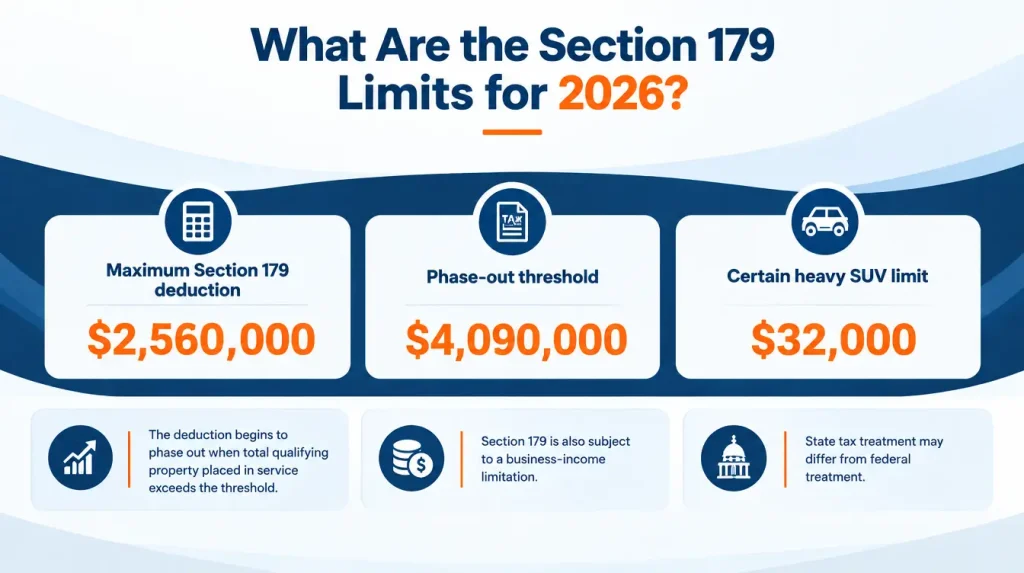
For tax years beginning in 2026, the federal Section 179 limits include:
- Maximum Section 179 deduction: $2,560,000
- Phase-out threshold: $4,090,000
- Certain heavy SUV Section 179 limit: $32,000
The phase-out means the available Section 179 deduction begins decreasing when the total amount of qualifying property placed in service during the year exceeds the applicable threshold.
Section 179 is also subject to a business-income limitation. This means a business may not necessarily be able to deduct the full maximum amount simply because it purchased enough qualifying equipment.
State treatment can also differ from federal tax treatment.
For that reason, businesses should confirm both federal and state consequences with their accountant or tax advisor.
Can Financed Equipment Qualify for Section 179?
Potentially, yes.
Financing equipment rather than paying the full purchase price in cash does not, by itself, make the equipment ineligible for Section 179.
IRS guidance on asset basis recognizes that the cost of property may include amounts paid through debt obligations. Section 179 separately focuses on whether the property qualifies, whether it was acquired by purchase, whether it was placed in service, and whether the applicable business-use and tax requirements are satisfied.
This means a business may finance qualifying equipment and potentially claim a Section 179 deduction even though payments on the financing continue beyond the year the equipment was purchased.
Businesses considering this approach should review their financing structure and tax treatment with a qualified tax professional.
If you are evaluating ways to purchase equipment without paying the entire cost upfront, learn more about our equipment financing options.
Why the “Placed in Service” Date Matters
Buying or ordering equipment is not always enough to claim Section 179 for a particular year.
The property generally must be placed in service during the tax year in which the Section 179 deduction is claimed.
Placed in service generally means the equipment is ready and available for its intended business use.
For example, equipment that is ordered late in the year but is not delivered, installed, or available for business use until the following year may not qualify for the deduction in the earlier year.
This distinction can be especially important for businesses making equipment purchases near year-end.
Businesses should confirm the timing with their tax professional rather than relying only on the purchase date, financing approval date, or payment date.
What Types of Business Equipment May Qualify?
Many types of business equipment may potentially qualify for Section 179 when the applicable requirements are satisfied.
Examples can include:
- Manufacturing machinery
- Construction equipment
- Commercial tools
- Computers and technology
- Office equipment
- Restaurant equipment
- Medical and dental equipment
- Warehouse equipment
- Certain business vehicles
- Certain qualified improvements to nonresidential real property, including qualifying roofs, HVAC systems, fire protection and alarm systems, security systems, and qualified improvement property.
Eligibility depends on the specific asset and how it is used.
Businesses should not assume that every equipment-related expense automatically qualifies.
If you are comparing different ways to fund an equipment purchase, our guide to the best equipment financing options for small business explains common financing structures and when each may make sense.
How Much Business Use Is Required?
Business use is an important part of Section 179 eligibility.
Property used for both business and personal purposes generally must be used more than 50% for business in the year it is placed in service to qualify for Section 179.
When property has both business and personal use, the deductible amount may also depend on the business-use percentage.
This can be particularly important for:
- Business vehicles
- Computers
- Technology
- Equipment used outside a business location
Businesses should also be aware that Section 179 recapture rules may apply if business use later falls to 50% or less during the applicable recovery period.
Section 179 Rules for Business Vehicles
Vehicles can have additional Section 179 restrictions.
For 2026, certain sport utility vehicles are subject to a $32,000 Section 179 limit.
Other depreciation limits and exceptions may also apply depending on the vehicle’s:
- Weight
- Design
- Classification
- Business-use percentage
- Intended business purpose
Because vehicle tax treatment can vary significantly, business owners should confirm the specific vehicle’s eligibility before purchasing or financing it based on an expected deduction.
Section 179 vs. Bonus Depreciation
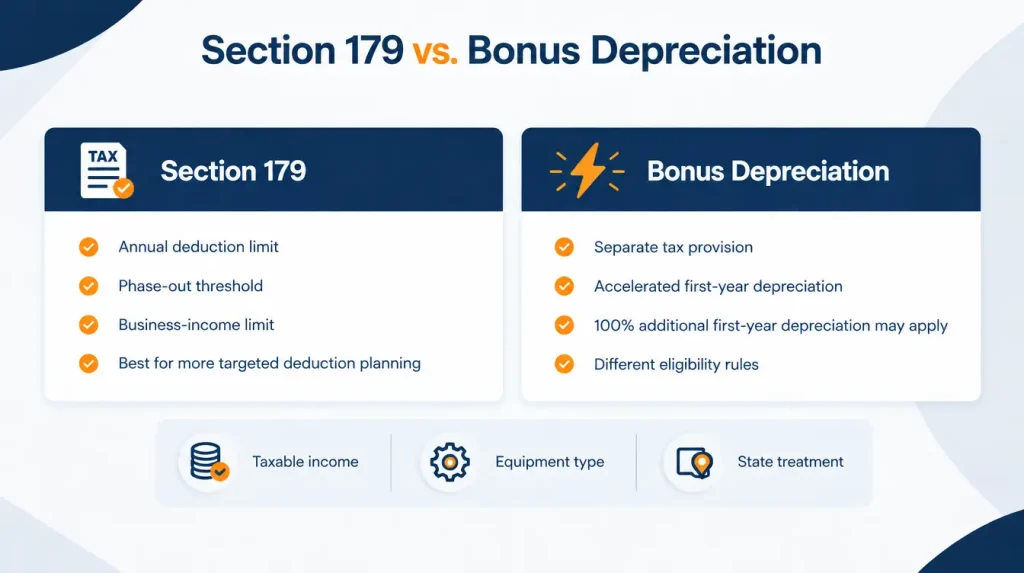
Section 179 and bonus depreciation are separate tax provisions.
Section 179
Section 179 allows eligible taxpayers to elect to expense qualifying property, subject to applicable deduction limits, phase-out rules, business-income limitations, and eligibility requirements.
Bonus Depreciation
Bonus depreciation follows a different set of rules and may also allow businesses to accelerate depreciation deductions for qualifying property.
Current federal law generally provides a 100% additional first-year depreciation deduction for qualifying property acquired after January 19, 2025, subject to applicable eligibility, acquisition, placed-in-service, and election rules.
Which method is more appropriate depends on factors such as:
- Business taxable income
- Type of equipment purchased
- Total equipment purchases
- Business-use percentage
- State tax treatment
- Long-term tax planning
Businesses should discuss Section 179 and bonus depreciation with a qualified tax professional before deciding which approach to use.
How Equipment Financing and Section 179 Can Work Together
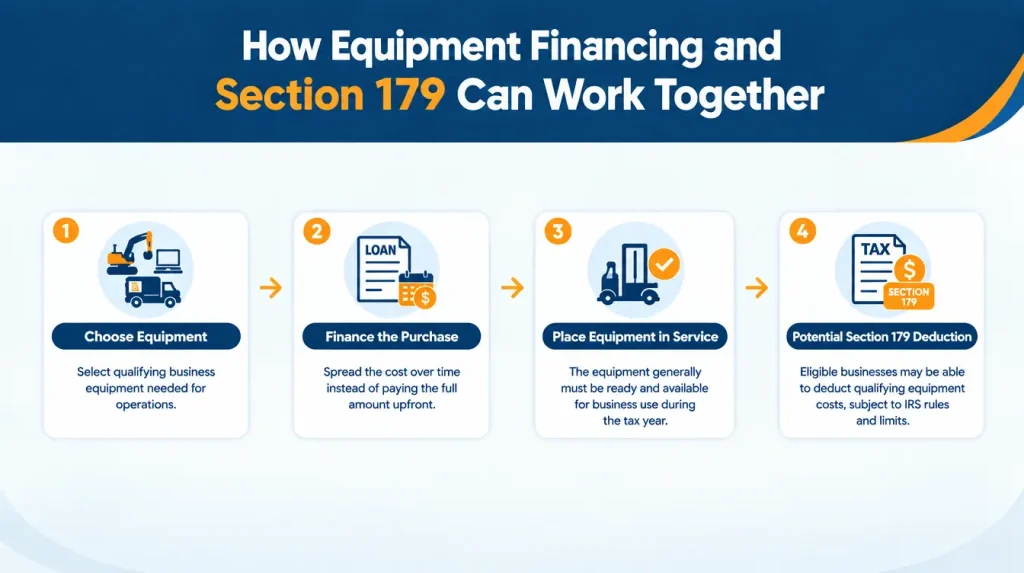
Equipment financing and Section 179 address two different parts of an equipment purchase.
Equipment financing determines how the business pays for the equipment.
Instead of using cash to cover the full purchase price upfront, a business may finance the equipment and repay the balance over an agreed term.
Section 179 addresses how eligible equipment may be treated for federal tax purposes.
When applicable requirements are satisfied, combining equipment financing with Section 179 may allow a business to:
- Acquire equipment needed for operations
- Spread payments over time
- Preserve working capital
- Put revenue-producing equipment into use sooner
- Potentially claim a current-year deduction for qualifying property
However, financing approval and Section 179 eligibility are separate considerations.
A financing company does not determine whether a business qualifies for a tax deduction.
Section 179 Checklist for Financed Equipment
Before purchasing or financing equipment based on Section 179, consider reviewing these questions with your tax professional:
- Is the equipment eligible Section 179 property?
- Is the transaction treated as a purchase for tax purposes?
- Will the equipment be placed in service during the intended tax year?
- Will business use exceed the required percentage?
- What portion of the equipment’s tax basis may qualify?
- Does the Section 179 deduction limit apply?
- Does the phase-out threshold affect the business?
- Does the business-income limitation reduce the available deduction?
- Are special vehicle rules involved?
- Would Section 179, bonus depreciation, regular depreciation, or a combination be more appropriate?
- Does the applicable state follow federal Section 179 treatment?
These questions can help businesses avoid making a major financing decision based on a tax assumption that may not apply to their situation.
Should You Finance Equipment to Take Advantage of Section 179?
Section 179 can be an important tax consideration, but it should not be the only reason to finance equipment.
Before financing an equipment purchase, businesses should also consider:
- Expected return from the equipment
- Monthly payment affordability
- Cash-flow impact
- Equipment lifespan
- Maintenance costs
- Ownership goals
- Financing costs
- Tax treatment
The right financing structure should support the business operationally and financially even before considering potential tax benefits.
For businesses planning a purchase, explore our equipment financing options to learn how financing may help spread equipment acquisition costs over time.
You can also compare different funding structures in our guide to the best equipment financing options for small business.
Important Tax Disclaimer
This article is provided for general educational purposes only and does not constitute tax, accounting, financial, or legal advice.
Section 179 eligibility and the amount of any available deduction depend on factors including the taxpayer, property type, transaction structure, business use, placed-in-service date, taxable income, and applicable federal and state tax rules.
Businesses should confirm their specific situation with a qualified CPA, tax attorney, or other qualified tax professional before purchasing or financing equipment based on an expected Section 179 deduction.