What Is DSCR?
DSCR stands for debt service coverage ratio. It measures whether the cash a property or business generates is enough to cover its debt payments.
• Debt service means the total principal and interest due over a period, usually one year.
• Coverage means how many times the available income covers those payments.
The OCC’s Comptroller’s Handbook on commercial real estate lending describes DSCR as a measure of “the borrower’s ability to service its debt,” calculated by dividing net operating income by annual debt service. Its glossary defines it more broadly as cash flow or NOI divided by debt service, which reflects that lenders apply the same idea to properties and to operating businesses.
Key Takeaways:
• DSCR (debt service coverage ratio) compares the income available to pay debt with the debt payments themselves. A ratio above 1.0 means income covers the payments; below 1.0 means it does not.
• For income-producing property, the basic formula is net operating income divided by annual debt service, which is how the OCC’s Comptroller’s Handbook describes it.
• Lenders use DSCR to size the loan amount, choose the structure, set covenants, and stress test how much room the borrower has if income falls.
• There is no single universal minimum. Federal bank guidance expects each lender to set its own DSCR standards by loan and property type, and SBA programs have their own rules.
• You can improve DSCR by raising income, cutting operating costs, borrowing less, or lowering the annual payment through a longer amortization or better rate.
If you have applied for a commercial mortgage or a larger business loan, you have probably been asked about your DSCR. It is one of the first numbers a commercial lender calculates, and it often decides how much you can borrow. This guide explains what DSCR means, how to calculate it, how lenders use it, and what to do if your ratio comes in low.
The DSCR Formula
For an income-producing property:
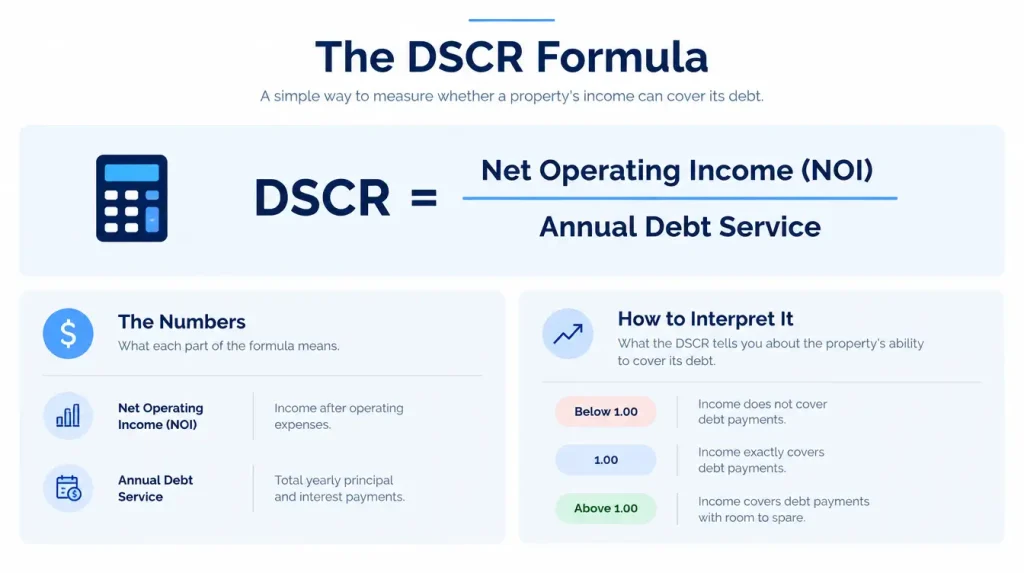
DSCR = Net Operating Income (NOI) / Annual Debt Service
• NOI is the property’s income after operating expenses such as property taxes, insurance, maintenance, utilities the owner pays, and management. It is calculated before loan payments and before income taxes. The OCC notes that lender NOI analysis may also include a vacancy allowance and reserves for capital replacements, so a lender’s NOI is often lower than the figure on a seller’s summary.
• Annual debt service is the total of all principal and interest payments for the year on the proposed loan, plus any other debt secured by the property.
How to read the result:
| DSCR | What it means |
| Below 1.00 | Income does not cover the payments. The shortfall has to come from somewhere else. |
| 1.00 | Income covers the payments exactly, with no cushion. |
| Above 1.00 | Income covers the payments with room to spare. The higher the number, the bigger the cushion. |
.
Types of DSCR Lenders Look At
The term DSCR shows up in a few different forms. Knowing which one a lender means avoids confusion.
Property DSCR
This is the version above, built on the property’s NOI. It is central for investment and rental property, where repayment depends on rents. The OCC handbook says repayment of loans on income-producing real estate “typically depends on the property’s ability to service debt from cash flow.”
Business DSCR
For an owner-occupied building or a business loan, the lender looks at the operating business instead of rents. The OCC handbook tells examiners that for owner-occupied buildings, analysis should “concentrate on the ability of the owner’s cash flow to service debt.” Lenders typically start from the business’s earnings, adjust for non-cash items and one-time costs, and divide by the debt service on all business debt, including the new loan.
Global DSCR
Global debt service coverage combines everyone who stands behind the loan. In their 2023 policy statement on commercial real estate workouts, the Federal Reserve, FDIC, NCUA, and OCC describe it as including “the cash flows generated by both the borrower(s) and guarantor(s), as well as the combined financial obligations (including contingent obligations)” of both. If you personally guarantee the loan, expect your personal income and debts to be part of the picture.
DSCR loans
You may also see lenders advertise “DSCR loans” for rental property investors, which qualify primarily on the property’s rental income. Terms and requirements vary widely by lender, so compare the full structure, not just the ratio.
Worked Example: Calculating DSCR on a Mixed-Use Building
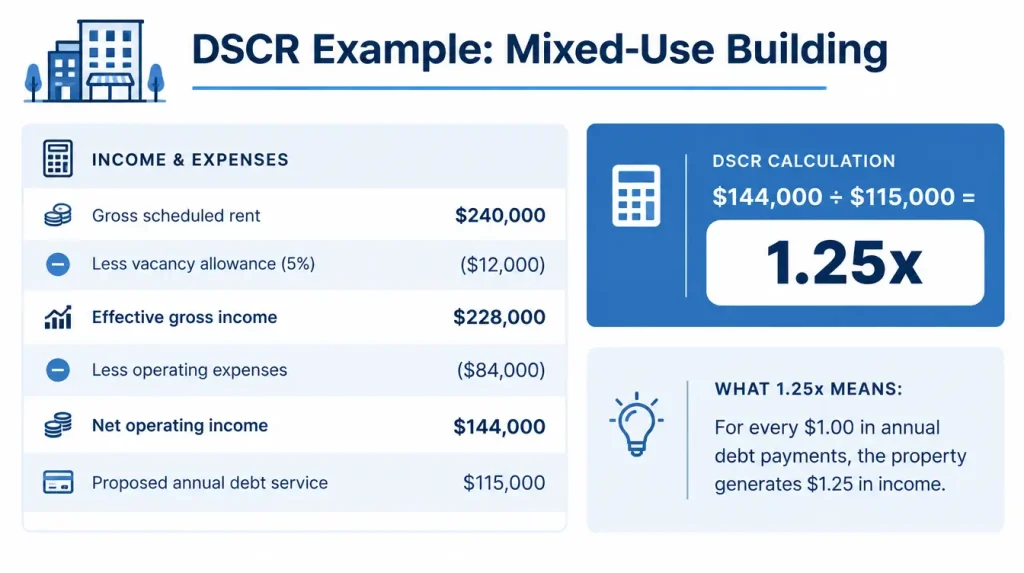
All numbers below are hypothetical and used for illustration only.
A buyer is financing an eight-unit mixed-use building with ground-floor retail.
| Line | Amount |
| Gross scheduled rent | $240,000 |
| Less vacancy allowance (5%) | ($12,000) |
| Effective gross income | $228,000 |
| Less operating expenses (taxes, insurance, maintenance, management, reserves) | ($84,000) |
| Net operating income | $144,000 |
| Proposed annual debt service | $115,000 |
0
DSCR = $144,000 / $115,000 = 1.25x
Income covers the proposed payments about one and a quarter times. Now see how a lender might use that number.
Stress test. If NOI fell 10% to $129,600, DSCR would drop to about 1.13x ($129,600 / $115,000). The OCC handbook says DSCRs should be stress tested so lenders can judge whether a property is likely to remain viable during economic stress.
Loan sizing. Suppose this lender’s policy for this property type called for a minimum of 1.30x (a hypothetical figure). The maximum annual debt service it could accept would be $144,000 / 1.30, or about $110,800. The proposed payment is roughly $4,200 a year too high, so the lender would likely offer a smaller loan, a longer amortization, or ask for more equity.
Business version. If the same buyer were instead an owner-occupant whose business earned $260,000 in cash flow available for debt service, carried $60,000 a year in existing debt payments, and was adding a $150,000 annual mortgage payment, business DSCR would be $260,000 / $210,000, or about 1.24x.
How Commercial Lenders Use DSCR
1. To size the loan
DSCR often sets the ceiling on how much you can borrow. The lender works backward from NOI or business cash flow and its required coverage to the largest payment it will accept, then converts that payment into a loan amount using the rate and amortization. That is why two buyers of the same property can be offered different amounts.
2. Alongside loan-to-value and other ratios
The OCC handbook lists DSCR next to loan-to-value limits, maximum loan terms, minimum debt yield, and amortization standards as core parts of a commercial real estate lending policy. A loan usually has to pass all of these tests, and the most restrictive one wins.
3. To choose the structure
The OCC handbook notes that an appropriate DSCR depends on the amortization period and how volatile the cash flow is. Stable properties with long-term leases to strong tenants may justify a lower ratio, while properties with volatile cash flows, such as hotels or owner-occupants with uneven earnings, may warrant a higher one. For interest-only loans, the handbook says lenders should still test coverage as though the loan were amortizing.
4. To write covenants
Many commercial loans include a DSCR covenant that the borrower must maintain after closing, often tested annually from financial statements. The OCC cautions that the covenant calculation can be defined differently from the DSCR used at underwriting, so read the definitions in your loan documents carefully.
What DSCR Do Lenders Require?
There is no universal approval threshold. Federal bank guidance expects each lender to set its own minimum standards for cash flow and debt service coverage by loan and property type, and those standards change with market conditions and the lender’s risk appetite.
Government-backed programs have their own rules. SBA’s 7(a) and 504 lending policies are set out in its SOP 50 10, and SBA issued SOP 50 10 8.1 effective 10/01/2026 for applications that receive an SBA loan number on or after that date. If you are pursuing an SBA loan, ask the lender which version applies and what coverage it requires for your loan type.
For a broader look at credit, down payment, documentation, and other approval factors, see our guide on how to qualify for a commercial mortgage.
How to Improve Your DSCR
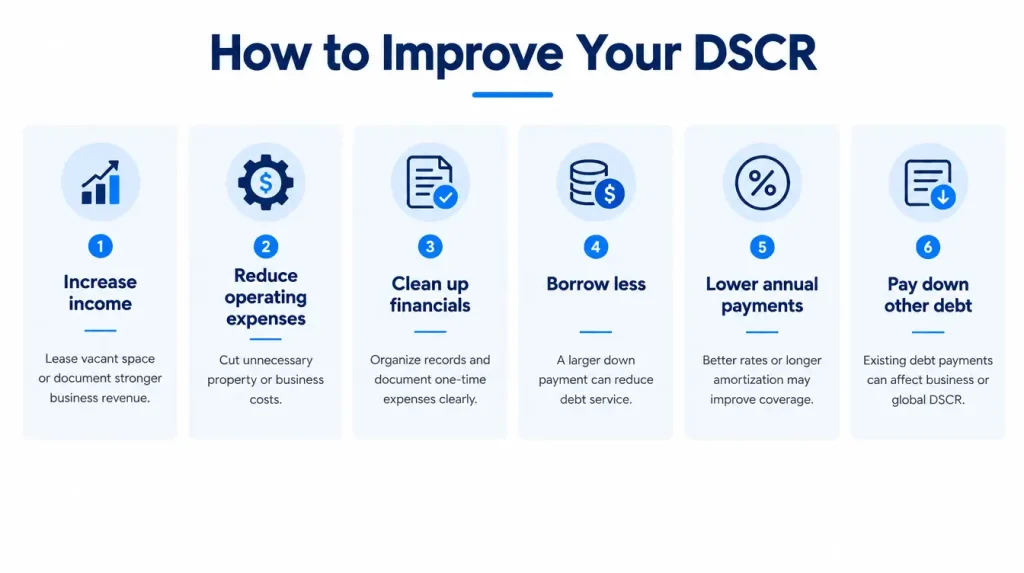
Because DSCR is a fraction, you can raise it by increasing the top number or shrinking the bottom one:
• Increase income. Lease vacant space, bring below-market rents up at renewal, or document new revenue that a lender can verify.
• Reduce operating expenses. Appeal property taxes, rebid insurance and service contracts, or address deferred maintenance that inflates repair costs.
• Clean up your financials. Separate personal and business expenses and document one-time costs so a lender can add them back.
• Borrow less. A larger down payment lowers annual debt service.
• Lower the annual payment. A longer amortization or a better rate reduces debt service on the same loan amount.
• Pay down other debt. Existing payments count against business and global DSCR.
Comparing Commercial Property Financing
DSCR is one input, not the whole decision. Owner-occupied buyers may compare a conventional commercial mortgage with SBA-backed options; our article on SBA 504 vs. a commercial mortgage walks through the trade-offs, and our SBA 7(a) and 504 loans page explains those programs.
When you are ready to look at real numbers, our commercial mortgages page explains how Committed to Capital compares options across its lending network for purchases, refinances, and renovations. You can also contact our team to talk through your property and cash flow.
This article is general educational information, not financial, legal, or tax advice. Lender requirements vary, and financing is subject to approval.