Key Takeaways:
- This ecommerce business loans guide explains how online sellers use financing to fund inventory, ad spend, fulfillment, and expansion without draining cash reserves.
- Ecommerce funding is not a single product but a category that includes term loans, lines of credit, inventory financing, revenue-based financing, invoice factoring, and SBA loans.
- The biggest reason online stores need capital is the cash flow gap between paying for inventory and marketing and actually collecting revenue from marketplace payouts.
- The right financing option depends on what you need the money for, how fast you need it, and your revenue, sales velocity, and time in business.
- Many ecommerce loans require no collateral and accept FICO scores as low as 500, using revenue and platform data instead of hard assets.
- Choosing the wrong structure or stacking loans without a plan can strain cash flow, so match the product to the specific need before you borrow.
Running an online store is one of the most cash-intensive business models in existence, and most sellers discover this the hard way. You spend on inventory, advertising, and fulfillment weeks before that money returns as collected revenue. This ecommerce business loans guide walks you through every funding option available to online sellers, how each one works, and how to choose the right structure for your store.
Whether you sell on Shopify, run an Amazon FBA operation, or manage a growing DTC brand, understanding your financing choices helps you scale without running out of working capital at the worst possible moment.
What is an Ecommerce Business Loan?
An Ecommerce Business Loan is any form of small business financing used by a company that sells products online, whether through its own store, a marketplace, or both. It is not one specific product. Instead, it is a category of funding options that includes term loans, lines of credit, inventory financing, revenue-based financing, invoice factoring, and SBA loans.
What makes ecommerce financing distinct is the underwriting approach. Traditional lenders often struggle to evaluate online sellers because these businesses rarely own physical storefronts, real estate, or heavy equipment. Specialized ecommerce lenders instead look at revenue, sales velocity, platform data from tools like Shopify and Amazon, and payment processor history. That shift lets asset-light online brands qualify based on how they actually perform rather than what they own.
Committed to Capital offers Ecommerce Business Loans designed specifically around how online-first brands operate, with fast approvals, flexible use of funds, and revenue-based underwriting.
Why Online Sellers Need Specialized Financing
The ecommerce model ties up cash long before revenue arrives. You pour money into stock, paid ads, and third-party logistics while platform payouts sit on hold for a week or two. A traditional bank loan, built for businesses with predictable balance sheets and physical collateral, rarely fits this rhythm.
Specialized financing accounts for the timing mismatch, funding your next inventory order or ad push based on proven sales rather than perfect credit or hard assets.
Get Funding Built for How Your Online Store Operates
If you are ready to match the right financing to your next inventory order, ad push, or expansion, request your funding options from Committed to Capital. Their team specializes in ecommerce lending, with same-day decisions, no collateral requirements, and approvals based on your revenue and sales velocity rather than credit alone.
How Do Ecommerce Business Loans Work?
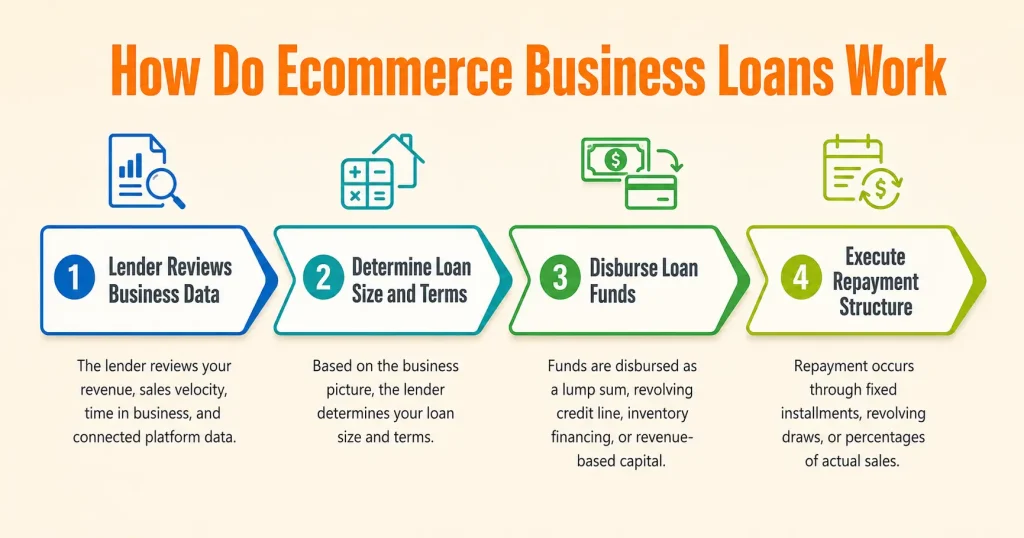
Ecommerce business loans provide capital to cover the specific costs of selling online, including inventory, advertising, fulfillment, software, and the gap between spending and collecting revenue.
The process usually starts with a lender reviewing your revenue, sales velocity, time in business, and connected platform data. Based on that picture, they determine your loan size and terms.
Once approved, funds are disbursed in one of several ways: a lump sum for a term loan, a revolving credit line you draw from as needed, inventory financing tied to a specific purchase order, or revenue-based capital repaid as a percentage of sales.
Repayment structures vary just as much. Some products use fixed daily or weekly installments, others let you draw and repay on a revolving basis, and revenue-based options flex with your actual sales.
With a line of credit, you only pay interest on the amount you actually use, which keeps costs down during slower periods. The right structure depends on whether your need is one-time, ongoing, or tied to a specific inventory cycle.
Why the Ecommerce Cash Flow Gap Makes Funding Essential
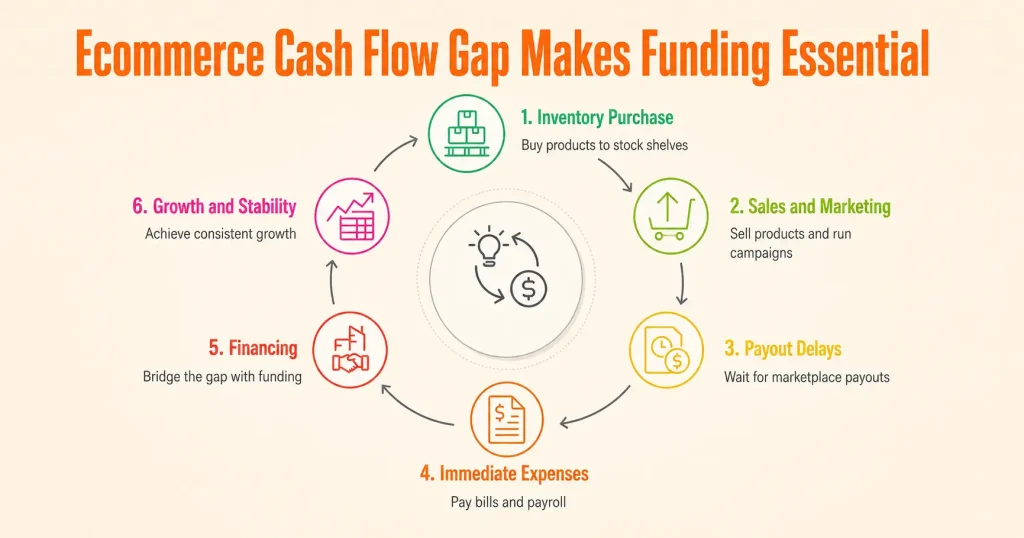
Every online seller knows the frustration of watching money leave the business long before it comes back. This timing problem, often called the cash conversion cycle, is the core reason ecommerce financing exists.
Consider a few common scenarios. A product goes viral and you need to triple your inventory before you sell out and lose search ranking. Ad spend has to scale today to capture demand, but the return will not land for weeks.
A supplier offers a deep discount on a bulk order you cannot fund right now. Meanwhile, marketplace payouts stay held for seven to fourteen days while payroll, software, and fulfillment invoices are all due immediately.
Financing bridges that gap. Instead of letting payout cycles dictate how fast you can grow, you keep shelves stocked, campaigns running, and suppliers paid on your own timeline. For sellers whose revenue swings with seasons or promotions, this steadiness is often the difference between compounding growth and stalling out.
Types of Ecommerce Business Loans (Every Option Explained)
Because ecommerce ties up cash across the entire sales cycle, most online sellers do not rely on a single financing product. Instead, they build a stack of solutions, drawing on different options as their needs shift from stocking inventory to scaling ads to funding a major expansion.
Understanding what each option does best helps you borrow with purpose rather than grabbing whatever funds fastest. Here are the main options online sellers use.
1. Short-Term Loans
A short-term loan delivers a lump sum quickly, often within 24 to 48 hours, repaid over three to 24 months through automated daily or weekly payments.
It is the go-to choice when speed matters most. If a product suddenly takes off, a supplier offers a limited-time discount, or you need to scale ad spend before a peak season, a short-term loan puts cash in your account fast enough to act on the opportunity.
The trade-off is cost. Because these loans fund quickly and require little paperwork, they typically carry higher rates than long-term or bank financing. They work best for short, revenue-generating needs you can repay quickly, not for long-term projects.
2. Lines of Credit
A line of credit gives you a pre-approved limit you draw against as needed, paying interest only on the amount you actually use. Once you repay what you have borrowed, the credit becomes available again.
This is the most flexible option available and works like a safety net for the unpredictable swings every online seller faces. Rather than applying for a new loan each time you need cash, you simply draw from your line, cover the expense, and repay as revenue comes in.
It suits recurring costs especially well, such as restocking inventory, smoothing out marketplace payout delays, or covering software and fulfillment fees between busy periods. If you want to understand the approval process for this option, our guide on how to qualify for a business line of credit breaks down exactly what lenders look for.
3. Inventory Financing
Inventory financing lets you purchase stock, often tied directly to a specific purchase order, without draining your working capital.
The inventory itself can serve as collateral, which means easier approvals and larger order sizes even for sellers with average credit. This lowers the risk for the lender and opens the door to bigger orders than you could fund out of pocket.
It is ideal for placing bulk orders, stocking up ahead of a busy season, or securing supplier volume discounts. For inventory-heavy businesses, this option keeps shelves full without forcing you to choose between stock and everyday operating cash.
4. Revenue-Based Financing
Revenue-based financing provides capital in exchange for a fixed percentage of your future sales. There is no rigid repayment term or fixed monthly payment.
Instead, repayment flexes with your performance. Payments shrink during slow weeks and rise during busy ones, tracking your actual sales velocity rather than a set calendar. That rhythm suits ecommerce especially well, since online revenue rarely arrives in even monthly amounts.
It is a strong fit for seasonal brands and sellers with solid overall revenue but uneven month-to-month sales. Our complete guide to revenue-based financing explains the mechanics in depth if this model fits your growth pattern.
5. SBA Loans
SBA loans, especially the SBA 7(a), offer some of the lowest rates and longest repayment terms available, backed partially by the U.S. Small Business Administration.
The trade-off is time and paperwork. Approval typically takes 30 to 90 days and requires strong documentation and credit. These loans are not built for urgent needs, but for planned, significant investments.
They fit established brands making major moves, such as acquiring another brand, buying warehouse space, or refinancing high-cost debt into a more affordable structure. When you have time to plan and want the lowest cost of capital, SBA financing is hard to beat.
6. Long-Term Loans
Long-term loans provide larger amounts with repayment stretched over two to ten years, which lowers your monthly payments and eases pressure on cash flow.
Because the balance is spread across a longer period, these loans suit significant capital projects that pay off gradually, such as fulfillment infrastructure, warehouse buildouts, or large product-line launches.
If your business also depends on machinery or fulfillment hardware, comparing purchase against rental options in our equipment financing vs. leasing guide can help you decide how to preserve cash while still getting the equipment you need.
What Ecommerce Businesses Actually Use Loans For
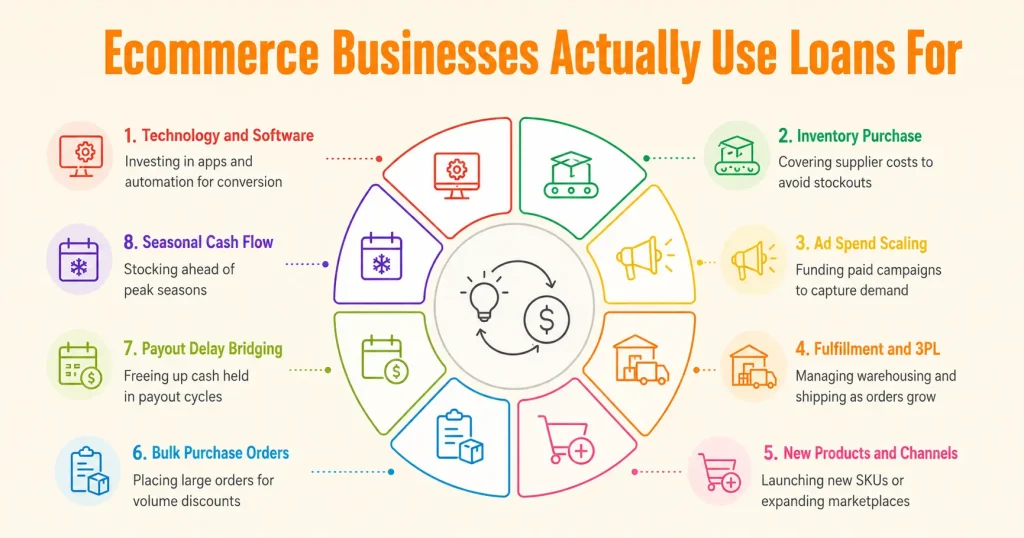
Online sellers put borrowed capital toward almost anything that keeps the store running or growing. The most common uses include:
- Purchasing inventory: Covering upfront supplier costs so you never lose sales to stockouts.
- Scaling ad spend: Funding paid campaigns on Meta, Google, TikTok, and Amazon to capture demand ahead of revenue.
- Fulfillment and 3PL: Covering warehousing, shipping, and third-party logistics as order volume climbs.
- Bridging payout delays: Freeing up cash held in marketplace and processor payout cycles.
- Bulk purchase orders: Placing large orders to lock in supplier volume discounts.
- New products and channels: Launching new SKUs or expanding into additional marketplaces.
- Seasonal cash flow: Stocking ahead of peak seasons while covering fixed costs.
- Technology and software: Investing in apps, automation, and analytics that drive conversion.
This flexibility is one of ecommerce financing’s biggest advantages. Most products let you deploy funds across inventory, marketing, fulfillment, and operations rather than locking capital into a single approved purpose.
How to Choose the Right Ecommerce Financing Option
The right ecommerce loan depends on three questions: what you need the money for, how quickly you need it, and your business profile.
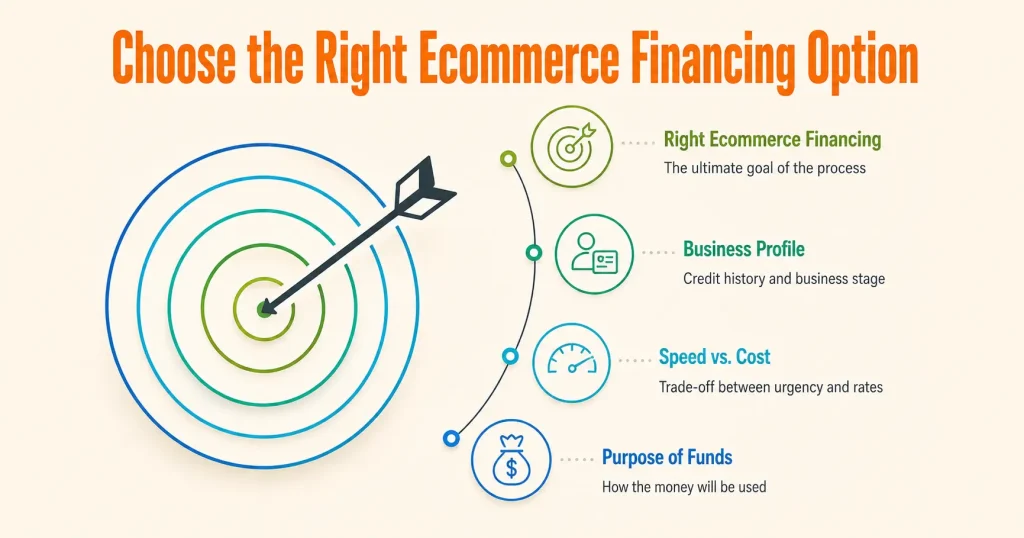
Start with purpose. A one-time bulk inventory order suits inventory financing or a short-term loan, while ongoing ad spend and recurring restocks fit a revolving line of credit far better. If your sales swing seasonally, revenue-based financing keeps payments aligned with income.
Next, weigh speed against cost. Faster, easier products like short-term loans and merchant cash advances fund within a day or two but carry higher rates. SBA and bank loans cost less but take weeks and demand heavy documentation. There is a genuine trade-off, and the best choice depends on how urgent the need is.
Finally, consider your profile. A newer store with strong daily sales but limited credit history has different best-fit options than an established brand with clean financials. Newer founders may also find our start-up funding guide useful for understanding early-stage capital.
Sellers who also operate physical production or private-label manufacturing can compare structures in our manufacturing business loans guide, and those running hybrid online-and-storefront models often find parallels in our restaurant business loans guide, which covers cost-timing challenges common to inventory-heavy operations.
How to Qualify for an Ecommerce Business Loan
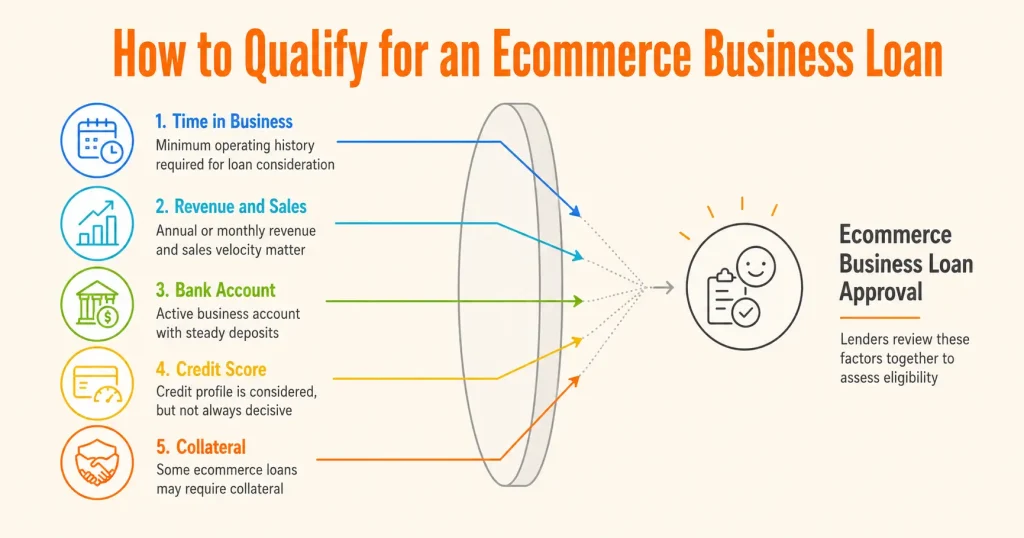
Qualification requirements vary by product, but most ecommerce lenders look at a consistent set of factors. Time in business matters, though many products fund sellers with only a few months of operating history. Annual or monthly revenue and sales velocity carry heavy weight, since they show your ability to repay. An active business bank account with steady deposits demonstrates healthy cash flow.
Credit is considered but rarely decisive. Many ecommerce products accept FICO scores as low as 500 because lenders weigh daily sales, processing volume, and overall revenue strength more heavily than a credit score.
Most options require no collateral, relying instead on platform data, payment processing history, and bank deposits. That approach is what makes financing accessible to asset-light online businesses that a traditional bank would struggle to underwrite.
Common Mistakes to Avoid When Borrowing
Even good financing can hurt a business when used carelessly. Watch for these pitfalls:
- Stacking multiple loans without a strategy, which creates overlapping payments and cash flow pressure.
- Scaling ad spend with borrowed money while return on ad spend is dropping, which compounds losses.
- Choosing the fastest product when you had time to pursue a cheaper one, paying a premium you did not need.
- Ignoring the personal guarantee, which most products require even for established brands.
- Borrowing for the wrong duration, such as using expensive short-term capital for a long-term project.
Matching the product to the specific need, and reading the terms carefully, keeps debt working for you rather than against you.
Bottom Line
Ecommerce financing exists to solve a problem every online seller faces: the gap between spending on inventory and ads and collecting the revenue those investments produce. As this ecommerce business loans guide has shown, the right solution is rarely a single product. It is a thoughtful mix matched to what you need funds for, how fast you need them, and where your business sits in its growth cycle.
Short-term loans and lines of credit handle speed and flexibility. Inventory and revenue-based financing align repayment with how you actually sell. SBA and long-term loans support larger, lower-cost investments.
The key is choosing deliberately, avoiding common mistakes, and working with a lender who understands the online model rather than forcing your business into a template built for brick-and-mortar retail.
Talk to an Ecommerce Funding Specialist Today
Ready to fund your next season, scale profitable ad spend, or expand into new channels? Speak with a Committed to Capital specialist to compare your options and find financing built around how your ecommerce business truly operates.