A restaurant in a beach town, ski area, or tourist district can be profitable for the year and still run out of cash in February. Summer or winter crowds bring in most of the revenue, while rent, insurance, and key staff continue all year. The owners who get through the slow season comfortably are usually the ones who planned for it in July.
Key Takeaways:
- A seasonal restaurant has to earn its year in a few busy months and then carry fixed costs through the slow ones. The money for the off-season has to be set aside during peak.
- The swing shows up nationally. Bureau of Labor Statistics data shows food services and drinking places employed about 641,500 more people in June 2025 than in January 2025, before seasonal adjustment.
- Separate fixed costs (rent, insurance, salaried staff, loan payments) from variable costs (food, beverage, hourly labor). Fixed costs are what the slow season has to cover.
- Build a 12-month cash plan from your own sales history, then a rolling 13-week forecast as the slow season approaches.
- Financing can bridge a predictable gap or fund pre-season needs, but it should not be used to cover a restaurant that loses money year-round.
This guide covers how seasonal revenue swings affect restaurant cash flow, how to handle payroll, rent, and inventory through the slow months, how much working capital to hold back, and when financing makes sense.
Why Seasonal Restaurants Run Short on Cash
Seasonal restaurants deal with the same cost structure as any other restaurant, with revenue concentrated into a shorter window.
The pattern is visible even in national data. In the Bureau of Labor Statistics’ Current Employment Statistics series for food services and drinking places, not seasonally adjusted, employment was 11,877,200 in January 2025 and 12,518,700 in June 2025, a difference of about 641,500 jobs. The same pattern repeated in 2026, from 12,007,800 in January to 12,644,400 in June. National averages smooth out local extremes, so a restaurant in a strongly seasonal market should rely on its own sales history rather than national figures.
Cash pressure is a common challenge for small businesses generally. In the Federal Reserve’s 2025 Report on Employer Firms, based on its 2024 Small Business Credit Survey, 56% of employer firms cited paying operating expenses and 51% cited uneven cash flows as financial challenges.
For a seasonal restaurant, the problem usually comes from four places:
- Fixed costs do not shrink with sales. Rent, insurance, equipment loans, and salaried managers cost the same in a slow month.
- Peak profits get spent. Owner draws, renovations, and equipment purchases made in a strong month can leave too little for winter.
- Pre-season costs arrive before revenue. Opening inventory, hiring, training, repairs, and marketing all happen before the first busy weekend.
- Surprises hit hardest when cash is lowest. An equipment failure in the off-season has no busy-season sales to absorb it.
Fixed Costs vs. Variable Costs
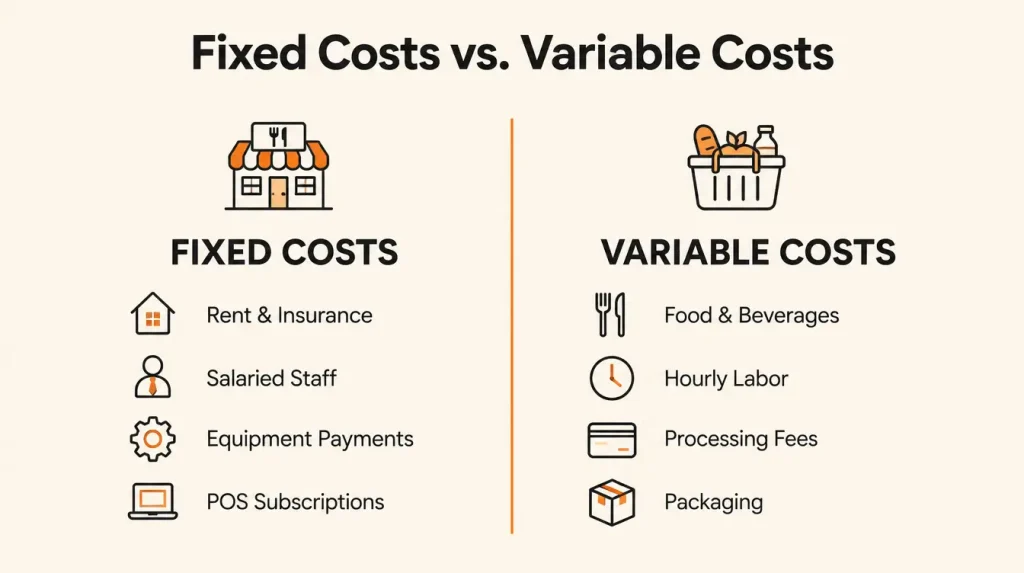
Start by splitting your costs into two groups.
| Fixed or mostly fixed | Variable with sales |
| Rent or mortgage | Food and beverage purchases |
| Insurance | Hourly kitchen and front-of-house labor |
| Salaried manager and chef pay | Credit card processing fees |
| Equipment and loan payments | Disposables and to-go packaging |
| Software, POS, and subscriptions | Some utilities |
Your slow-season cash need is roughly your fixed costs, minus whatever contribution slow-month sales still produce. That number, multiplied by the number of slow months, is what the busy season has to fund.
Managing the Big Cost Lines Through the Slow Season
Payroll
Payroll is usually the largest controllable cost. Seasonal restaurants typically reduce hours, shorten service, or close certain days in the off-season, while keeping a core team so they can reopen strong. Payroll taxes do not pause: IRS Publication 15 generally requires employers to deposit employment taxes on a monthly or semiweekly schedule, and tips are considered paid when employees report them. Include those deposits in your slow-season plan.
Rent and occupancy
Rent is the hardest cost to cut quickly. If your lease is up for renewal, it may be worth asking the landlord about a payment schedule that reflects your season. Either way, set aside rent for the slow months first, before the owner draws or discretionary spending.
Inventory
Holding too much inventory into the slow season ties up cash and risks spoilage. Lower par levels as traffic drops, trim the menu to items that share ingredients, and time big purchases for when you need them. Before the busy season, the opposite applies: the opening order and pre-season stock-up can be one of the largest single cash outflows of the year.
Repairs and equipment
The off-season is often the best time for repairs, maintenance, and upgrades, because the kitchen is quieter. It is also when cash is lowest. Budget for these projects during peak, or match them with financing whose term fits the equipment’s life. Our equipment financing page explains how equipment purchases can be spread over time.
How Much Working Capital Should a Seasonal Restaurant Hold?
There is no universal rule. The useful answer comes from your own numbers: add up the cash shortfall for every slow month, add your pre-season opening costs, and add a cushion for an unexpected repair. That total is the amount you need to have in reserve, available credit, or both by the end of your busy season.
Worked Example: A Shore Restaurant’s 12-Month Plan
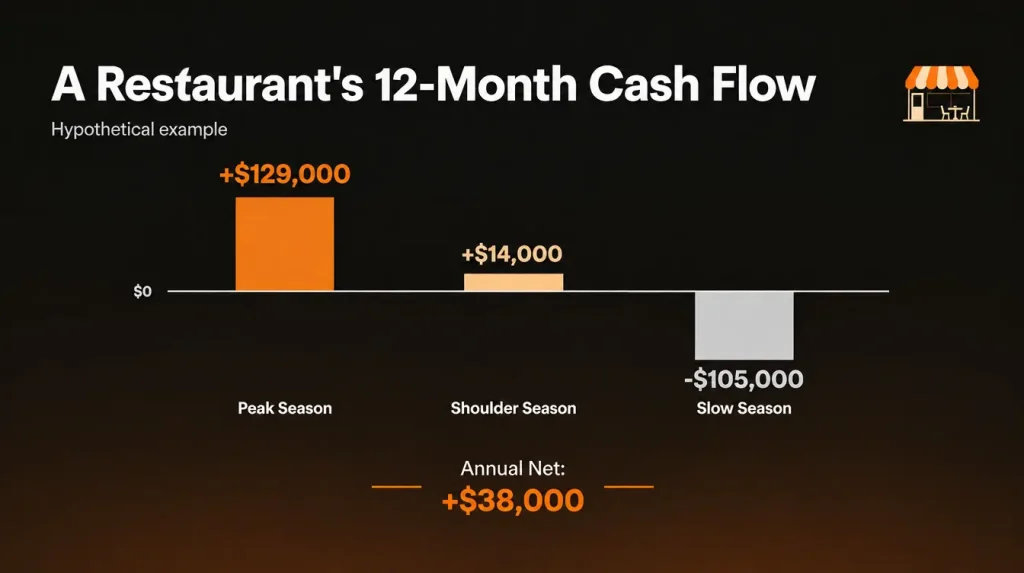
The numbers below are hypothetical and used for illustration only.
A beach-town restaurant has three peak months, two shoulder months, and seven slow months. Variable costs run about 60% of sales, so each dollar of sales contributes about 40 cents toward fixed costs. Fixed costs are $29,000 a month (rent $9,000, insurance, utilities, and loan payments $6,000, and core salaried staff $14,000).
| Period | Monthly sales | Contribution (40%) | Less fixed costs | Monthly result | Months | Period total |
| Peak (June to August) | $180,000 | $72,000 | $29,000 | +$43,000 | 3 | +$129,000 |
| Shoulder (May, September) | $90,000 | $36,000 | $29,000 | +$7,000 | 2 | +$14,000 |
| Slow (October to April) | $35,000 | $14,000 | $29,000 | ($15,000) | 7 | ($105,000) |
| Year | +$38,000 |
The restaurant is profitable for the year, but only if $105,000 of the summer’s cash is still in the bank when October arrives. If the owner spent $60,000 of peak cash on a patio renovation, the restaurant would face a shortfall late in the slow season, right when it also needs cash for the pre-season stock-up in April and May. Seeing this in July gives the owner choices: delay the renovation, finance it over a term that fits its life, or arrange a credit line for the spring gap before it is urgently needed.
Build a Rolling 13-Week Cash Forecast
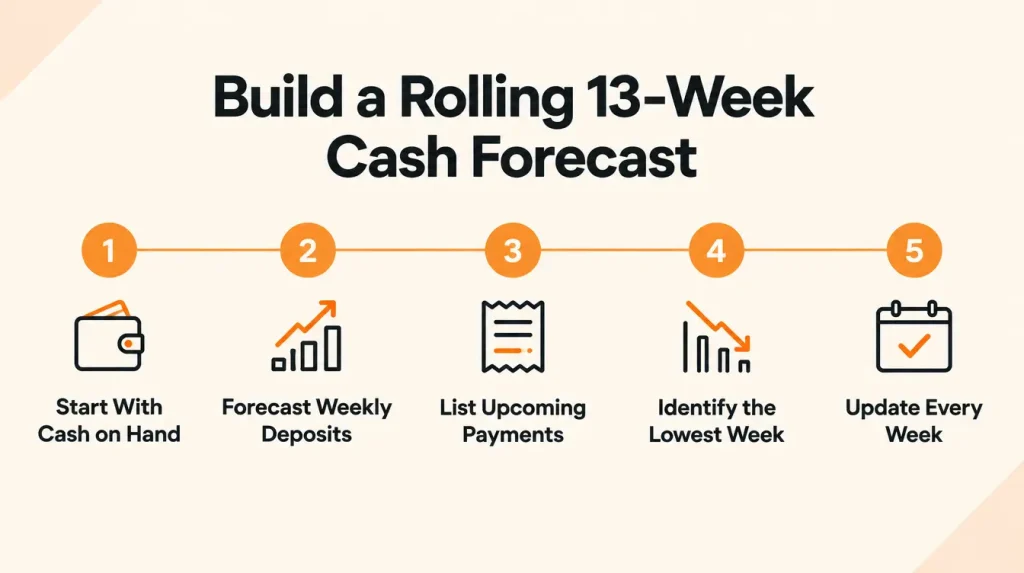
A 12-month plan sets the target. A rolling 13-week forecast keeps you on it.
- Start with cash on hand today.
- List expected deposits week by week, using last year’s sales for the same weeks.
- List every known payment: payroll and payroll tax deposits, rent, vendor invoices, loan payments, insurance, and sales tax.
- Find the lowest week.
- Update the forecast every week as actual results come in.
If the lowest week drops below your minimum cash balance, you have weeks, not days, to cut costs, delay spending, or line up funding.
When Financing Makes Sense, and When It Does Not
Financing works best for a seasonal restaurant when the gap is temporary and the repayment source is clear.
- A business line of credit fits recurring, predictable gaps, such as pre-season inventory and hiring, because you draw only what you need and repay it once the busy season starts. The restaurant in our North Carolina restaurant case study used a revolving line of credit to repair a broken walk-in cooler, buy needed equipment, and increase inventory ahead of its busy season. See how a business line of credit is structured.
- Equipment financing or a term loan fits off-season renovations and equipment purchases that pay back over several years.
- Revenue-based financing ties payments to sales, which can ease slow months, but it can cost more. Compare total cost and model it against your slowest month.
Financing is the wrong tool when the restaurant loses money for the year as a whole. If the 12-month plan shows a loss, borrowing only adds a payment. Address menu pricing, food cost, labor scheduling, or lease terms first.
For a fuller overview of restaurant financing, visit our restaurant business loans page. For seasonal planning across industries, see seasonal planning with working capital. When you are ready to talk through your slow-season plan, contact Committed to Capital.
This article is general educational information, not financial, legal, or tax advice. Financing is subject to lender approval, and terms, costs, and availability vary. Talk with your accountant about payroll tax and other tax obligations.