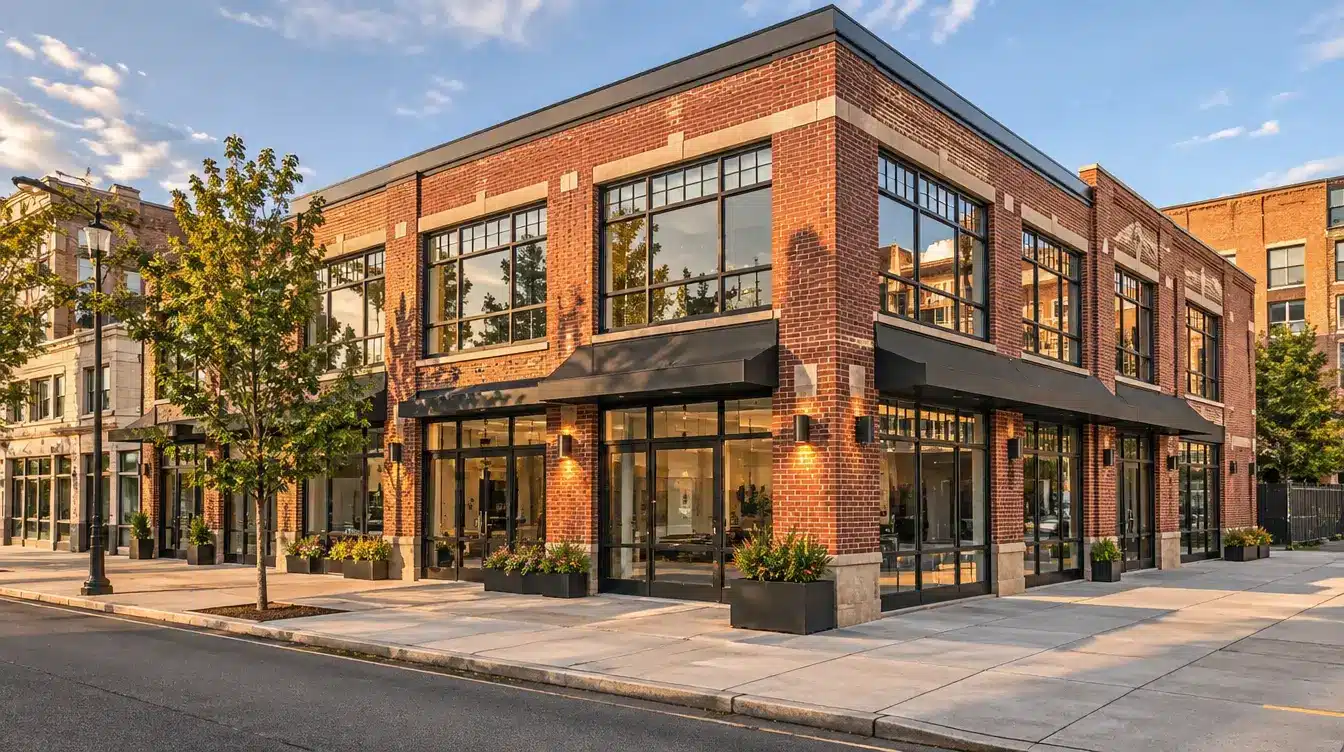
Buying a commercial property in Philadelphia can give your business greater control over its location, monthly occupancy costs, and long-term growth. But finding the right Philadelphia commercial mortgage requires more than comparing interest rates.
Whether you’re purchasing a retail storefront in Center City, expanding a medical practice in University City, or financing a warehouse in South Philadelphia, understanding your borrowing options can help you avoid expensive mistakes.
A commercial mortgage loan is financing used to purchase, refinance, construct, or improve commercial real estate. Lenders evaluate the property, your financial position, available cash flow, and ability to repay the debt.
For Philadelphia business owners, financing options may include conventional commercial mortgages, SBA 504 loans, SBA 7(a) loans, and private commercial real estate financing.
This guide explains the different loan types, qualification requirements, closing costs, and 10 practical tips for securing commercial property financing in Philadelphia, Pennsylvania.
Key Takeaways
- Commercial mortgage loans help Philadelphia businesses purchase, refinance, or improve commercial properties.
- Down payments depend on the program. Conventional financing often requires approximately 20% to 35% equity, while qualifying SBA 504 projects may require less.
- Lenders review DSCR, credit, loan-to-value ratio, business cash flow, and property condition before making a financing decision.
- Philadelphia zoning rules and realty transfer taxes can affect property eligibility and total acquisition costs.
- SBA 504 and SBA 7(a) loans can support qualifying owner-occupied commercial real estate purchases.
- Comparing loan terms, prepayment provisions, and closing costs is just as important as comparing interest rates.
Understanding Commercial Mortgage Loans in Philadelphia
A commercial mortgage loan in Philadelphia provides financing secured by property used for business operations or commercial investment.
Unlike a residential mortgage, which generally emphasizes personal income and household debt, a commercial property loan may be evaluated using business financial statements, property cash flow, collateral value, and borrower experience.
Philadelphia businesses commonly use commercial mortgage financing for:
- Retail properties: Storefronts in Center City, South Street, and neighborhood shopping corridors.
- Office buildings: Professional offices in University City, Center City, and Northeast Philadelphia.
- Mixed-use properties: Buildings combining commercial space and apartments in Fishtown or Northern Liberties.
- Industrial properties: Warehouses, workshops, and distribution facilities in South Philadelphia and nearby industrial corridors.
- Healthcare properties: Medical, dental, and specialty healthcare offices.
- Business property refinancing: Replacing an existing commercial mortgage or accessing equity where permitted.
Commercial loan terms vary by lender and product. Some conventional loans mature after five or 10 years but calculate payments over a longer amortization period, potentially leaving a balloon payment at maturity. SBA-backed real estate financing may offer longer repayment terms.
How much can you borrow? Your available financing typically depends on the property’s appraised value, purchase price, cash flow, loan-to-value ratio (LTV), and the lender’s underwriting standards.
For more information, explore Committed to Capital’s commercial mortgage financing options.
Philadelphia Commercial Real Estate Market Overview
Philadelphia has a diverse commercial real estate market supported by healthcare, higher education, professional services, manufacturing, logistics, and neighborhood businesses.
However, local property performance varies significantly by location and asset class.
For example, CBRE’s Q3 2026 Philadelphia office market report reported a 22.3% office vacancy rate alongside continued leasing activity. That illustrates why commercial property buyers should evaluate individual buildings rather than assume every location offers the same investment potential.
Important Philadelphia Commercial Property Areas
- Center City: Office buildings, retail businesses, restaurants, and professional services. Buyers should evaluate building condition, tenant demand, and operating costs.
- University City: Healthcare, research, education, and professional office uses. Property suitability depends on the intended business and location.
- Fishtown and Northern Liberties: Neighborhood retail, restaurants, and mixed-use properties where zoning and building conversions may require additional review.
- South Philadelphia: Industrial properties, warehouses, logistics businesses, and commercial facilities near transportation infrastructure.
- Northeast Philadelphia: Retail centers, light industrial properties, professional offices, and established commercial corridors.
When evaluating a commercial building loan in Pennsylvania, consider:
- Current and permitted property use
- Commercial property taxes and insurance
- Neighborhood vacancy and tenant demand
- Building condition and renovation requirements
- Transportation, parking, and customer accessibility
- Potential resale value and long-term occupancy needs
Commercial Mortgage Financing in Bucks County and Nearby Areas
Businesses in Bucks County, PA, including Doylestown, Bensalem, Bristol, and Newtown, can explore commercial mortgage options for purchasing or refinancing offices, retail spaces, warehouses, and other business properties.
Financing options may include conventional commercial mortgages, SBA 7(a) loans, and SBA 504 loans, depending on eligibility, property use, and financial qualifications. Committed to Capital can help businesses explore suitable commercial real estate financing options in Bucks County and the greater Philadelphia area.
Local tip: Before purchasing a property, check the City’s Atlas zoning and property information resources.
Types of Commercial Mortgage Loans Available in Philadelphia
Philadelphia business owners can choose from several commercial real estate financing programs. The right option depends on whether your business will occupy the property, your available down payment, and how you plan to use the building.
SBA 504 Loans
An SBA 504 loan is designed to help eligible small businesses finance major fixed assets, including owner-occupied commercial real estate and certain long-term equipment.
A standard SBA 504 project typically combines financing from a private lender and a Certified Development Company (CDC), along with a borrower equity contribution.
Key features include:
- Borrower equity contributions starting as little as 10% for eligible standard projects
- Long-term fixed-rate financing on the CDC-backed portion
- Available 10-, 20-, and 25-year CDC loan maturities
- Financing for eligible building purchases, construction, and improvements
- Additional equity requirements for some new businesses or special-purpose properties
SBA 504 financing is not intended for speculative real estate investment or ordinary rental property purchases.
A Philadelphia manufacturer purchasing a facility for its own operations, for example, may consider SBA 504 financing if it meets the applicable eligibility and occupancy requirements.
Learn more about SBA 7(a) and 504 loans or review the official SBA 504 program.
SBA 7(a) Loans
SBA 7(a) loans offer another financing option for eligible small businesses purchasing or improving commercial real estate.
Unlike SBA 504 financing, SBA 7(a) loans may also support eligible working capital, equipment purchases, and certain other business expenses.
Depending on program requirements, real estate loans may have repayment terms extending up to 25 years.
SBA 7(a) financing may be useful when a Philadelphia business needs to purchase a commercial property while financing other eligible expansion expenses.
However, eligibility, collateral, personal guarantees, equity requirements, and loan structure depend on the transaction.
Traditional Bank Commercial Loans
Traditional banks and commercial lenders offer financing for properties such as offices, retail spaces, warehouses, and mixed-use developments.
Common requirements include:
- Strong personal and business credit
- Documented income and repayment capacity
- Sufficient down payment and cash reserves
- Acceptable loan-to-value ratio
- Property appraisal and underwriting approval
Many conventional commercial mortgages are structured around approximately 65% to 80% LTV, although individual requirements vary.
Traditional financing may be suitable for established businesses or commercial real estate investors with stable financial records.
Private and Alternative Lenders
Private commercial mortgage lenders may provide financing when a property or borrower does not fit conventional banking requirements.
Potential uses include:
- Short-term acquisition financing
- Commercial bridge loans
- Property renovation projects
- Refinancing transactions
- Properties requiring additional work before permanent financing
These lenders may offer different underwriting requirements or timelines, but borrowing costs, fees, collateral requirements, and repayment risks can be higher.
Always compare the total financing cost and exit strategy before accepting a private commercial loan.
CMBS Loans
Commercial Mortgage-Backed Securities (CMBS) financing is generally associated with income-producing commercial property, often involving larger transactions.
Potential advantages include access to longer-term commercial property financing and nonrecourse structures in certain transactions.
However, CMBS loans can have detailed servicing requirements, cash management provisions, and significant prepayment restrictions.
For many small business owner-occupants in Philadelphia, SBA-backed or conventional financing may be more practical.
10 Commercial Mortgage Loan Tips for Philadelphia Business Owners
Getting approved for a Pennsylvania commercial mortgage requires careful preparation.
These 10 tips can help you compare financing options, understand lender requirements, and make a more informed commercial property investment decision.
1. Understand Your Property Classification Before Applying
Commercial property classification affects which financing programs may be available.
A lender may underwrite a warehouse differently from a restaurant, medical office, apartment building, or mixed-use property.
Before submitting an application, identify:
- Whether the property is owner-occupied or investment real estate
- Its current legal use and zoning classification
- Any proposed renovations or changes of use
- Existing tenants and lease agreements
- Property size, condition, and occupancy status
For example, an owner-operated warehouse in South Philadelphia may qualify for financing programs that are not available to an investor purchasing a fully leased apartment building.
SBA occupancy requirements matter. Under federal regulations, an eligible business generally must occupy at least 51% of an existing building or 60% of new construction financed under applicable SBA real estate rules, with additional conditions for leasing remaining space.
Philadelphia also requires appropriate zoning authorization for certain property uses and changes of use.
Action tip: Verify zoning, occupancy, and intended use before committing to a commercial property purchase.
2. Strengthen Your Debt Service Coverage Ratio (DSCR)
Your debt service coverage ratio (DSCR) helps lenders determine whether available income can support loan payments.
For income-producing commercial property, the basic formula is:
DSCR = Net Operating Income ÷ Annual Debt Service
For an owner-occupied building, lenders generally examine the operating business’s adjusted cash flow and overall debt obligations rather than relying only on rental income.
Example:
Suppose a Philadelphia commercial property produces:
- Annual net operating income: $150,000
- Annual debt payments: $120,000
DSCR = $150,000 ÷ $120,000 = 1.25x
A 1.25x DSCR means the property generates $1.25 in net operating income for every $1.00 of annual debt service.
Many conventional commercial lenders look for a repayment cushion above 1.00x, but there is no universal minimum. Requirements depend on the lender, property type, financing program, and cash flow risk.
Ways to improve DSCR include increasing operating income, reducing expenses, paying down existing debt, or contributing more equity to lower the proposed mortgage payment.
Read our complete guide to what DSCR means and how lenders use it.
3. Maintain at Least Two Years of Organized Financial Statements
Accurate financial records help a commercial mortgage lender assess your business’s financial condition and repayment capacity.
Established businesses should generally prepare two to three years of financial history when available.
Useful documents include:
- Business balance sheets
- Profit and loss statements
- Cash flow statements
- Business tax returns
- Current debt schedules
- Financial projections when appropriate
Lenders want to understand more than your revenue.
They may investigate declining profitability, unusually large expenses, seasonal income fluctuations, outstanding tax obligations, and existing loans.
If your business has experienced a temporary revenue decline, provide an explanation supported by financial records rather than leaving lenders to interpret the numbers themselves.
Action tip: Review your financial statements with your accountant before submitting a commercial mortgage application.
4. Prepare Tax Returns, P&L Statements, and Bank Records in Advance
Incomplete documents can slow commercial mortgage underwriting.
Before applying for a commercial building loan in Pennsylvania, organize the financial and property information lenders are likely to request.
Business and borrower documents:
- Business and personal tax returns, as requested
- Year-to-date profit and loss statement
- Business balance sheet
- Recent business bank statements
- Personal financial statement
- Business ownership and entity documents
- Existing loan balances and repayment obligations
Property documents:
- Purchase agreement or refinancing details
- Property address and description
- Current rent roll, if applicable
- Existing leases and operating statements
- Renovation budget, if applicable
- Available building plans and property records
Requirements vary, so a lender may request additional documents during underwriting.
For an investment property, lenders may focus on rent rolls, tenant quality, vacancy assumptions, and property net operating income.
For an owner-occupied property, operating business cash flow is especially important.
Action tip: Create one organized digital folder for all borrower and property documents before requesting formal loan proposals.
5. Understand Loan-to-Value Ratios and Down Payment Requirements
The loan-to-value ratio (LTV) compares the mortgage amount with the property’s value.
It helps lenders measure how much collateral supports the proposed loan.
LTV = Loan Amount ÷ Property Value × 100
Consider a hypothetical Philadelphia commercial property purchased for $1 million.
| Financing component | Amount |
|---|---|
| Property purchase price | $1,000,000 |
| Proposed commercial mortgage | $750,000 |
| Borrower equity | $250,000 |
| Loan-to-value ratio | 75% |
In this example, the buyer needs $250,000 in equity before accounting for closing costs and reserves.
Actual calculations can depend on appraisal results, purchase price, lender policy, and program requirements.
Conventional commercial mortgages frequently require meaningful equity contributions. Some eligible SBA 504 projects may have lower initial equity requirements.
Action tip: Calculate your available down payment, closing costs, and remaining cash reserves before choosing a financing program.
Do not use every available dollar for the down payment if your business will still need liquidity for operations and unexpected property expenses.
6. Budget for Appraisal, Legal, Environmental, and Inspection Costs
Commercial mortgage costs extend beyond the loan’s interest rate and down payment.
Philadelphia property buyers should prepare for expenses such as:
- Commercial property appraisal
- Title examination and title insurance
- Legal and settlement fees
- Building inspection
- Environmental assessment, when required
- Survey and property documentation
- Lender origination and underwriting fees
- Insurance and tax adjustments
- Realty transfer taxes
Important Philadelphia consideration: The City’s published combined realty transfer tax rate is 4.578%, consisting of the City and Commonwealth portions.
For a straightforward $1 million taxable property transfer, this represents $45,780 in combined transfer tax before considering transaction-specific adjustments or exemptions.
The tax is commonly divided between buyer and seller, but the allocation is negotiable and should be confirmed in the purchase agreement.
Review the City of Philadelphia’s Realty Transfer Tax guidance before calculating closing costs.
Older commercial buildings and properties with past industrial uses may also require additional environmental or structural investigation.
Action tip: Request a preliminary closing-cost estimate early and confirm which costs are paid by the buyer.
7. Compare Fixed and Variable Interest Rate Options Carefully
Commercial mortgage interest rates influence your monthly payment, financing costs, and long-term cash flow.
Two common structures are fixed-rate and variable-rate financing.
Fixed-rate commercial mortgages
A fixed rate remains unchanged for the specified fixed-rate period.
Potential benefits include predictable payments and easier budgeting.
However, some commercial mortgages offer a fixed rate only during an initial loan term, rather than for the entire amortization period.
Variable-rate commercial mortgages
A variable rate may change according to a benchmark rate and the lender’s agreed margin.
The initial rate may be lower in some offers, but future payment increases can create additional financial pressure.
Before choosing either option, compare:
- Interest rate and adjustment frequency
- Monthly debt payments
- Total interest and fees
- Rate caps or floors
- Amortization period
- Loan maturity and balloon payment
- Refinancing options
Action tip: Compare complete financing proposals rather than selecting a lender based only on the advertised interest rate.
8. Review Prepayment Penalties Before Signing
Some commercial mortgage loans charge fees when you repay the debt earlier than the agreed schedule.
Prepayment provisions can be particularly important when you expect to sell, refinance, or relocate your business.
Depending on the loan structure, these provisions may include:
- Fixed prepayment charges
- Step-down penalty schedules
- Yield maintenance
- Defeasance requirements
- Program-specific restrictions
For example, a Philadelphia business owner purchasing a building today may want to refinance several years later if the business expands or its financing needs change.
A restrictive prepayment clause could make that transaction expensive.
Action tip: Ask your lender for a written explanation of what happens if you sell or refinance the building in years three, five, or seven.
Compare loan flexibility alongside the interest rate.
9. Lock Your Rate Strategically Based on Market Timing
Commercial mortgage rates can change during the financing process.
Some lenders offer rate-lock options, while others finalize pricing closer to closing.
Before locking an interest rate, ask:
- When does the rate become fixed?
- How long does the lock remain valid?
- Is there a rate-lock fee?
- Can the rate change if closing is delayed?
- What happens if the appraisal or loan amount changes?
Waiting for a lower rate does not guarantee better financing.
A delayed closing could also create additional legal, inspection, or purchase agreement costs.
Action tip: Consider your expected closing schedule, cash flow, and total loan cost when evaluating rate-lock options.
Your decision should reflect the actual financing terms available to you, not a prediction about where interest rates will move.
10. Work With a Funding Advisor Familiar With Philadelphia Lending Conditions
Commercial financing can become more complicated when a transaction involves multiple lenders, unusual property types, mixed-use buildings, or renovation requirements.
A commercial mortgage funding advisor can help you understand available programs and compare how different lenders evaluate a proposed transaction.
For example, you may need to compare:
- Conventional commercial mortgage financing
- SBA 504 property financing
- SBA 7(a) financing
- Commercial bridge loans
- Private real estate lending
- Commercial property refinancing options
For businesses seeking commercial real estate debt advisory in Philadelphia, useful guidance should include financing structure, collateral requirements, cash flow, closing costs, and potential repayment risks.
Philadelphia-specific considerations also matter.
A Center City commercial office purchase may involve different underwriting concerns from a mixed-use building in Northern Liberties or an industrial property near the Port of Philadelphia.
Business mortgages in neighboring Bucks County may involve different local taxes and zoning requirements.
Action tip: Ask your advisor or lender to explain why a financing program fits your property, how much cash you will need at closing, and what risks remain after approval.
You can explore small business financing options in Philadelphia or contact Committed to Capital to discuss your commercial property financing needs.
Common Commercial Mortgage Mistakes Philadelphia Business Owners Make
Commercial property purchases involve financial commitments that can extend for many years.
Avoiding the following mistakes can make the process more manageable.
Underestimating total property costs: Buying a commercial building involves more than the purchase price. Budget for maintenance, insurance, property taxes, repairs, and closing expenses.
Ignoring zoning and permitted use: A property may not be approved for the activity your business intends to operate. A change of use could require a zoning permit or other approvals.
Assuming every property qualifies for SBA financing: SBA real estate financing generally focuses on qualifying owner-occupied business property, not speculative investment real estate.
Choosing a loan based only on interest rate: A lower rate may be less attractive if the loan includes expensive fees, short maturity, or significant prepayment restrictions.
Applying before understanding eligibility: Review your available equity, cash flow, credit profile, and property details before committing to a lender.
Ignoring refinance and balloon payment risk: If the loan matures before the mortgage is fully amortized, you may need to refinance or repay the remaining balance.
The best commercial mortgage is not necessarily the one with the lowest initial payment. It is the financing structure that your business can realistically afford and manage over time.
How to Qualify for a Commercial Mortgage in Philadelphia, PA
Qualifying for a Philadelphia commercial mortgage depends on the financial strength of the borrower, the type of property, and the specific loan program.
Most commercial mortgage lenders review several key factors.
Credit History
Your personal and business credit history can influence approval, pricing, and financing terms.
There is no universal minimum credit score that applies to every commercial mortgage lender.
A stronger credit profile generally provides access to more financing options.
Business Revenue and Cash Flow
Lenders want evidence that your business or property produces sufficient cash flow to cover operating expenses and debt payments.
They may analyze historical income, adjusted earnings, and your DSCR.
Time in Business
Established businesses often have more financial history to support their applications.
However, some programs may consider newer businesses when the owners have relevant experience, adequate equity, and a credible repayment plan.
Down Payment and Cash Reserves
Commercial real estate financing typically requires some borrower equity.
Lenders may also look at cash available after closing to support future payments and property expenses.
Property Appraisal and Condition
The property must generally provide acceptable collateral value.
Lenders may review the appraisal, physical condition, permitted use, environmental history, and potential income.
Complete Financial Documentation
Organized tax returns, financial statements, bank records, and property information help lenders assess your application.
For a more detailed explanation, read our guide on how to qualify for a commercial mortgage.
Bottom line: Approval is not based on one credit score or financial ratio. Lenders assess the entire borrower and property risk profile.
Commercial Mortgage vs. Leasing in Philadelphia: Which Is Better?
Deciding whether to purchase or lease commercial property depends on your financial position, business stability, and future space requirements.
| Factor | Buying Commercial Property | Leasing Commercial Property |
|---|---|---|
| Upfront capital | Requires down payment and closing costs | Often requires security deposit and initial lease expenses |
| Equity | Can build ownership equity | Does not create property ownership equity |
| Flexibility | Selling or relocating may take time | Relocation may be easier at lease expiration |
| Monthly costs | Mortgage, insurance, taxes, maintenance | Rent and lease-related charges |
| Property control | Greater control, subject to regulations | Subject to lease terms and landlord approvals |
| Long-term risks | Property value, repairs, and refinancing | Rent increases, renewal terms, and lease restrictions |
When Buying May Make Sense
Buying commercial property may be suitable if:
- Your business expects to remain in the same location long term.
- You have enough cash for the down payment and reserves.
- Your revenue can support mortgage payments and ownership expenses.
- You want greater control over renovations and property use.
When Leasing May Make Sense
Leasing may be more appropriate if:
- Your business is new or growing quickly.
- You expect your location or space requirements to change.
- You need to preserve cash for hiring, equipment, or inventory.
- You are uncertain about long-term property ownership costs.
Is a commercial mortgage worth it? It may be worthwhile when ownership offers long-term operational benefits and your expected costs are affordable. Compare the total cost of buying with the total cost of leasing over the period your business expects to use the property.
Step-by-Step Process to Secure a Commercial Mortgage in Philadelphia
The application process varies depending on the loan program, property type, and lender.
However, most transactions follow a similar sequence.
Step 1: Review Your Financing Goals
Determine how much property financing you need, your available down payment, and whether the building will be owner-occupied or used as an investment.
Step 2: Evaluate the Property
Review the purchase price, zoning, building condition, occupancy, income potential, and expected renovation expenses.
Step 3: Compare Lenders and Prequalify
Discuss your business financials, credit profile, property requirements, and loan amount with potential lenders or a funding advisor.
Compare conventional financing, SBA loans, and other suitable options.
Step 4: Submit Documents and Complete Underwriting
Provide the required financial statements, tax returns, property details, and other supporting records.
The lender evaluates repayment ability, collateral, and transaction risk.
Step 5: Complete Appraisal and Property Due Diligence
The lender may require a commercial appraisal, environmental review, title work, building inspection, or additional documentation.
Resolve any material property or legal issues before closing.
Step 6: Review Loan Terms and Close
Review the final interest rate, fees, amortization, maturity, payment requirements, prepayment provisions, and closing costs.
Once the lender’s conditions are satisfied, the transaction can proceed to closing.
How long does the process take? Some commercial mortgages may close within approximately 30 to 90 days, but this is only a planning range. SBA financing, construction projects, environmental issues, or complex property transactions can take longer.
Start the financing discussion before your purchase agreement deadlines become difficult to meet.
Why Philadelphia Business Owners Choose Committed to Capital
Finding a suitable commercial mortgage requires comparing financing programs, understanding lender requirements, and choosing terms that fit your business.
At Committed to Capital, we help business owners explore commercial mortgage financing solutions based on their property goals, financial circumstances, and borrowing needs.
Whether you are purchasing a Philadelphia retail storefront, refinancing a business property, or evaluating financing for an industrial facility, our team can help you compare available options.
How We Can Help
- Explore available commercial mortgage programs
- Compare suitable lenders and financing structures
- Understand commercial property loan requirements
- Review down payment and documentation expectations
- Evaluate SBA-backed and conventional financing options
Our goal is to help you make an informed financing decision with a clear understanding of the proposed terms and obligations.
Planning a commercial property purchase in Philadelphia?
Contact Committed to Capital to discuss your property, business goals, and possible financing options.
All financing is subject to lender review, eligibility, and approval.
Final Thoughts
A Philadelphia commercial mortgage can help business owners purchase, improve, or refinance commercial real estate while building a longer-term business property strategy.
However, property ownership also creates responsibilities that go beyond monthly loan payments.
Before applying, understand the property’s zoning and condition, calculate your available equity, review your DSCR, and compare financing programs carefully.
The right approach depends on whether you need an owner-occupied business property, a commercial investment loan, or financing for a larger expansion project.
By preparing documents early, budgeting for Philadelphia-specific closing costs, and reviewing the full loan structure, you can make a more confident commercial financing decision.
Ready to explore commercial mortgage loans in Philadelphia, PA?
Visit our commercial mortgage financing page to learn more about available options and the next steps.