Key Takeaways:
- SBA loans are not government loans. The U.S. Small Business Administration guarantees a portion of a loan issued by an approved lender, which is why these programs carry longer terms and lower rates than most conventional business financing.
- The SBA 7(a) loan is the flexible, general-purpose program, with a maximum loan amount of $5 million for most loans and eligible uses spanning working capital, acquisitions, refinancing, equipment, and real estate.
- The SBA 504 loan is built for major fixed assets like owner-occupied commercial property and long-life equipment, structured across a bank, a Certified Development Company, and your down payment.
- As of July 4, 2026, the SBA decoupled the two programs, so eligible borrowers can hold up to $5 million in 7(a) and up to $5 million in 504 at the same time, for as much as $10 million in combined SBA-backed financing.
- 7(a) pricing is usually variable, built from a base rate plus an SBA-capped lender spread, while the CDC portion of a 504 loan carries a fixed rate set when the debenture sells.
- The single biggest factor in how fast an SBA loan closes is the completeness of your application package, not the size of your business.
Most business owners hear “SBA loan” and picture one product. In reality, the Small Business Administration backs several distinct programs, and the two that matter most for growing companies work in almost opposite ways. One is flexible and general-purpose. The other is narrow, fixed-rate, and built entirely around long-lived assets.
Choosing wrong costs you time, and sometimes the deal. A business that applies for a 504 loan when it really needs working capital will spend weeks in underwriting before hearing no. A business that uses a 7(a) for a building purchase may leave a lower fixed rate on the table.
This guide explains how SBA loans work, what separates the 7(a) from the 504, how rates and fees are actually built, who qualifies, and how to move through the application without the delays that stall most first-time applicants.
Not Sure Which SBA Program Fits Your Project?
Committed to Capital works with SBA-approved lenders and Certified Development Companies across New Jersey, Pennsylvania, Delaware, Maryland, New York, and nationwide. Talk to a specialist about your project and get a straight answer on which program fits before you start assembling paperwork.
What is an SBA Loan and How Does It Work?
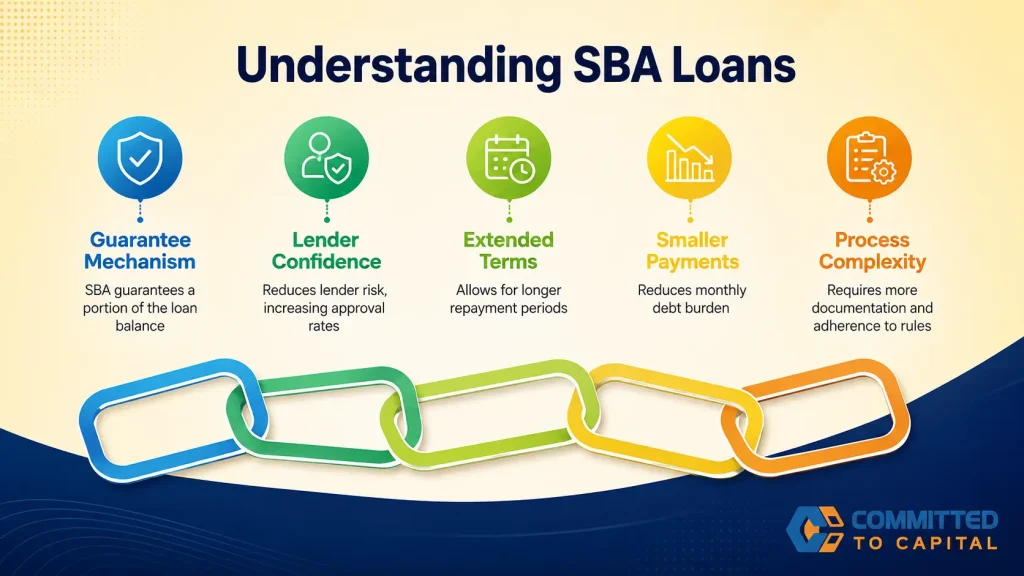
An SBA loan is a business loan issued by a bank, credit union, or non-bank lender in which the U.S. Small Business Administration guarantees a portion of the balance. The SBA does not lend the money directly in these programs. It reduces the lender’s downside, which changes what the lender is willing to approve.
That guarantee is the whole mechanism. A bank looking at a ten-year loan against a business with modest collateral might decline it outright. With 75% of the balance federally guaranteed, the same file becomes approvable, and the lender can stretch the term far beyond what conventional underwriting allows. Longer terms mean smaller payments, and smaller payments mean the business can carry the debt while still funding operations.
The tradeoff is process. Because federal dollars stand behind the loan, eligibility is defined by rule rather than by lender preference, and documentation runs deeper than a conventional application.
Who Actually Lends the Money?
For a 7(a), a single SBA-approved lender originates and services the loan. For a 504, two lenders are involved: a conventional bank takes the senior position, and a Certified Development Company (CDC), a nonprofit certified by the SBA, funds the SBA-backed portion. That second party is a large part of why 504 timelines run longer than 7(a) timelines.
SBA 7(a) Loans Explained
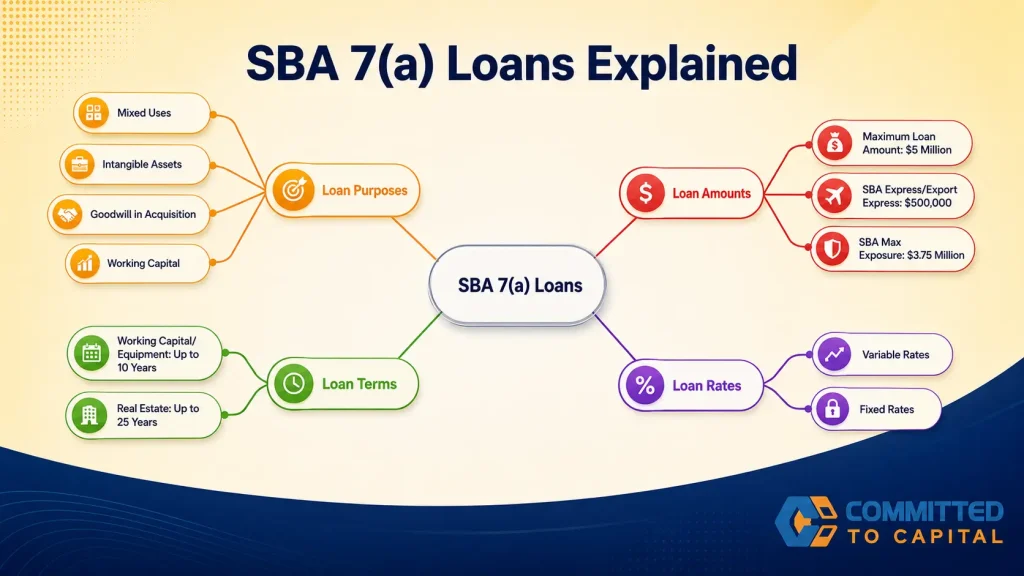
The 7(a) is the SBA’s primary and most widely used program. It exists to cover the situations conventional lending handles poorly: mixed uses, intangible assets, goodwill in an acquisition, and working capital on a term longer than three years.
Per the SBA’s terms and conditions page, most 7(a) loans have a maximum loan amount of $5 million, while loans made under the SBA Express and Export Express delivery methods cap at $500,000. The SBA’s maximum exposure, meaning the dollars actually guaranteed, is $3.75 million.
Terms follow the use of funds. Working capital and equipment typically run up to 10 years; when real estate is part of the deal, the term can extend to 25 years. Rates are usually variable, though fixed-rate 7(a) loans exist and are subject to separately published SBA maximums.
What You Can Use a 7(a) Loan For
The SBA lists eligible uses broadly. 7(a) proceeds can go toward acquiring, refinancing, or improving real estate and buildings; short- and long-term working capital; refinancing existing business debt; purchasing and installing machinery and equipment; buying furniture, fixtures, and supplies; complete or partial changes of ownership; and multiple-purpose loans combining any of the above.
That last item is the program’s real advantage. A single 7(a) can fund an acquisition, the working capital to operate the acquired business, and the equipment it needs, all under one note and one payment.
7(a) Variations Worth Knowing
SBA Express trades a lower ceiling for a faster SBA turnaround, which suits smaller working-capital needs. Export-focused variants serve businesses selling internationally. For most owners, the standard 7(a) is the relevant product.
SBA 504 Loans Explained
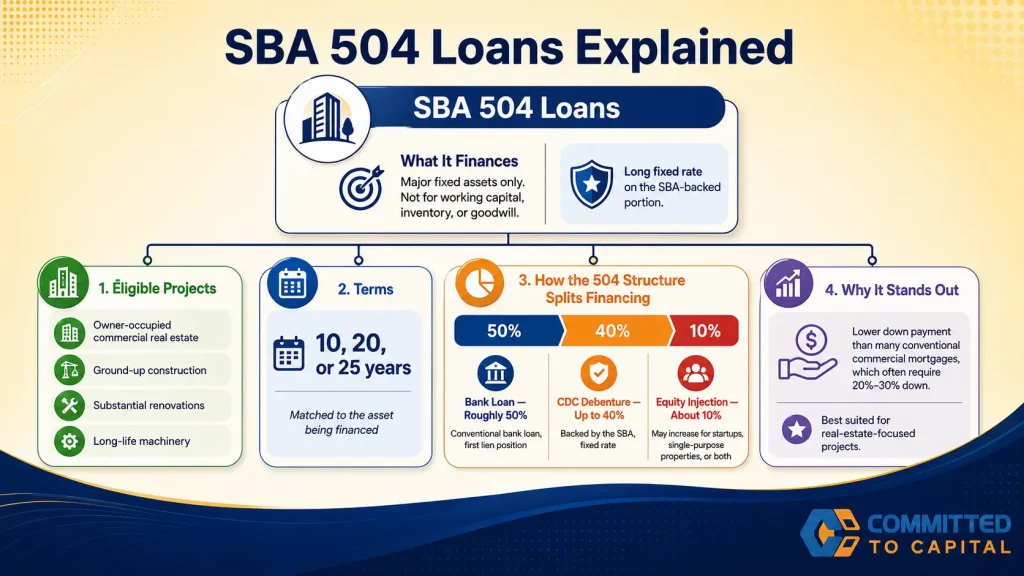
The 504 loan finances major fixed assets and nothing else. It cannot fund working capital, inventory, or goodwill. What it offers in exchange is a long, fixed rate on the SBA-backed portion, which is difficult to match anywhere else in commercial lending.
Eligible projects center on owner-occupied commercial real estate, ground-up construction, substantial renovations, and long-life machinery. Terms run 10, 20, or 25 years, matched to the asset being financed.
How the 504 Structure Splits the Financing
A standard 504 project breaks into three pieces:
- A conventional bank loan covering roughly 50% of the project, in first lien position
- A CDC debenture covering up to 40%, backed by the SBA, at a fixed rate
- Your equity injection of about 10%, which can increase for startups, single-purpose properties, or both
That structure is why the down payment is unusually low for a commercial property purchase. Conventional commercial mortgages commonly require 20% to 30% down. If your project is primarily real estate and you want to compare paths, our commercial mortgage financing options sit alongside the 504 as an alternative worth pricing.
The Occupancy Rule Most Applicants Miss
A 504 requires the business to occupy a majority of the property. For an existing building, that generally means at least 51%. For new construction, the threshold is higher. Investment property does not qualify, and this disqualifies more applicants than any other 504 rule.
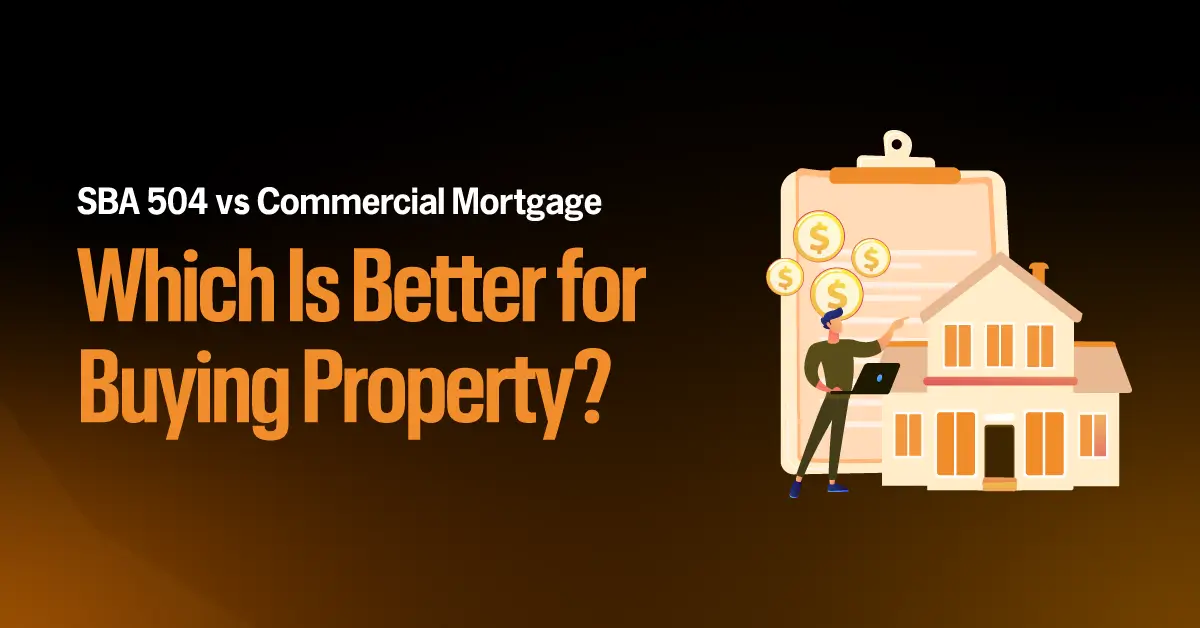
SBA 7(a) vs. 504: Which Loan Fits Your Business?
The decision usually resolves in one question: is the centerpiece of your plan a single long-lived asset, or is it a mix of needs?
| SBA 7(a) | SBA 504 | |
| Best for | Working capital, acquisitions, refinancing, mixed uses | Owner-occupied real estate, long-life equipment |
| Maximum | $5 million ($500,000 for Express) | SBA-backed portion up to $5.5 million per project |
| Rate type | Usually variable, capped by the SBA | Fixed on the CDC portion |
| Term | Up to 10 years, up to 25 with real estate | 10, 20, or 25 years |
| Down payment | Typically around 10%, varies by use | Typically around 10%, higher for special-use property |
| Parties | One SBA-approved lender | Bank plus a Certified Development Company |
| Speed | Generally faster to close | Generally slower, due to the CDC step |
Two scenarios make the split concrete. A contractor buying a $1.4 million shop building it will occupy fits the 504 cleanly, locking a fixed rate over 25 years. A buyer acquiring a $900,000 distribution business, where most of the value is goodwill, customer contracts, and inventory, fits the 7(a), because a 504 cannot touch any of it.
When You Can Use Both
On July 7, 2026, the SBA announced that borrowers may now combine their 7(a) and 504 loans for up to $10 million in SBA-backed financing, up from the previous cumulative limit of $5 million. The policy change took effect on July 4, 2026. Under the rule, qualified borrowers who secure a 7(a) loan first may access up to $5 million through 7(a) and up to $5 million through 504.
The individual program caps did not change. What changed is that a 7(a) balance no longer eats into 504 capacity. For a capital-intensive expansion involving a building, equipment, and the operating capital to run both, this is the most useful SBA development in years.
SBA Loan Rates, Fees, and Total Cost
7(a) rates are built from two parts: an SBA-approved base rate, most often the Wall Street Journal Prime Rate, plus a lender spread that the SBA caps by loan size. The spread shrinks as the loan grows, so larger loans carry lower ceilings.
The WSJ Prime Rate stood at 6.75% as of July 2026 (per NerdWallet’s SBA rate tracker and SBA Loan Index, both citing Federal Reserve data). Confirm the current figure before relying on it, because the base rate resets whenever the Federal Reserve moves.
504 pricing works differently. The CDC portion is priced off Treasury yields on a monthly pricing date and fixes for the life of the loan when the debenture sells. As of July 9, 2026, the 20-year debenture priced at 6.2% and the 25-year at 6.172%, per SBA Loan Index. The bank’s senior portion is priced separately and negotiated conventionally.
Rates are not the whole cost. Expect an SBA guarantee fee on the guaranteed portion of a 7(a), CDC processing and servicing fees on a 504, plus appraisal, environmental, title, and closing costs on any real estate deal. Ask every lender for the total cost including fees rather than comparing quoted rates alone, because two offers at the same rate can differ meaningfully once fees are stacked in.
SBA Loan Eligibility Requirements
The SBA sets a baseline that applies before any lender’s own credit standards. To be eligible, a business must be an operating business, operate for profit, be located in the U.S., be small under SBA size requirements, not be a type of ineligible business, be unable to obtain the desired credit on reasonable terms from non-federal, non-state, and non-local government sources, and be creditworthy with a reasonable ability to repay.
That “credit elsewhere” test surprises people. The SBA is a backstop, not a first stop. If your business could get the same financing conventionally, you are not meant to be in the program.
Lenders layer their own requirements on top. In practice, most SBA lenders look for:
- A personal credit score in the high 600s or better from each owner of 20% or more
- At least two years of business tax returns and current interim financials
- Cash flow that comfortably covers the proposed payment
- An equity injection, commonly around 10% of project cost
- A registered entity in good standing, with clean ownership documentation
- Personal guarantees from all 20%-or-greater owners
Ineligible categories include passive real estate holding, lending businesses, and speculative ventures, among others.
How to Apply for an SBA Loan, Step by Step
- Define the use of funds precisely. Program eligibility follows the use, not the amount. “Expansion” is not specific enough to route you correctly.
- Assemble the financial package first. Three years of business and personal tax returns, interim financials, a debt schedule, and ownership documents. Real estate deals add purchase agreements, appraisals, and environmental reports.
- Match to the right lender. SBA-approved lenders have industry preferences, size preferences, and geographic focus. Applying to a poor fit is the most common cause of a wasted eight weeks.
- Submit and respond quickly. Underwriting generates follow-up requests. The applicants who close fastest answer within a day.nj
- Move through commitment and closing. A 7(a) commonly closes faster than a 504, which requires the CDC and the senior lender to align.
Realistic timelines run from several weeks to a few months depending on program, lender, and file quality. Ecommerce and inventory-heavy sellers in particular often find their working capital gap needs a faster instrument alongside the SBA process, which we cover in our complete funding guide for online sellers.
Common Mistakes That Stall SBA Applications
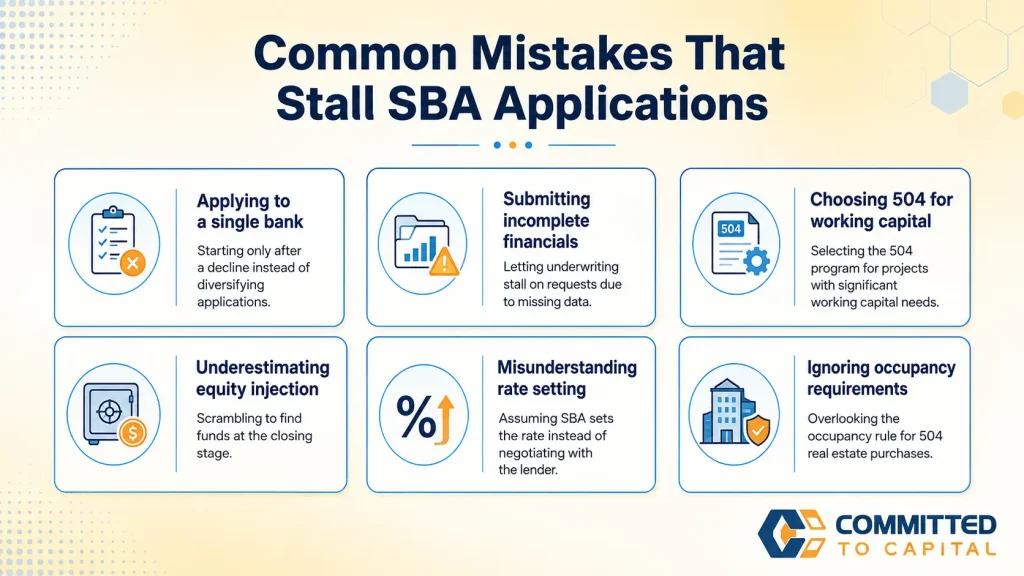
- Applying to a single bank and starting over after a decline
- Submitting incomplete financials and letting underwriting stall on requests
- Choosing the 504 for a project that includes significant working capital
- Underestimating the equity injection and scrambling at closing
- Assuming the SBA sets your rate, when the lender negotiates it within the cap
- Ignoring the occupancy requirement on a 504 real estate purchase
Get Your SBA Application Right the First Time
Ready to Compare Your SBA Options?
SBA terms come from the SBA. Your speed and your outcome come from how well the file is prepared and how well the lender fits your profile. Committed to Capital guides you through program selection, package preparation, and lender matching so the application moves instead of stalling.
Review the full SBA 7(a) and 504 loan program details, or request a consultation to talk through your project with someone who has structured deals like it.
Final Thoughts
SBA loans remain among the most affordable financing available to an established small business, but only when the program matches the project. Use the 7(a) when your needs are mixed, intangible, or operational. Use the 504 when a building or a piece of long-life equipment is the center of the plan. Since July 4, 2026, you may be able to use both.
Everything else comes down to preparation. Verify current rates and fees with your lender before you commit, because base rates and debenture pricing move on their own schedule. Then put a complete, accurate package in front of a lender that actually wants your deal. That combination decides how this goes far more than the loan amount does.
Frequently Asked Questions About SBA Loans
What are SBA loan requirements?
SBA loan requirements include operating as a for-profit business in the United States, meeting SBA size standards, and demonstrating the ability to repay. Lenders typically add their own thresholds: two or more years in business, a personal credit score in the high 600s, positive cash flow, and an equity injection of roughly 10%. All owners of 20% or more must personally guarantee the loan.
How much can you borrow with an SBA loan?
Most SBA 7(a) loans cap at $5 million, and SBA Express loans cap at $500,000. The SBA-backed portion of a 504 loan reaches up to $5.5 million per project. Since July 4, 2026, eligible borrowers can hold both, for up to $10 million in combined SBA-backed financing.
What is the difference between an SBA 7(a) and a 504 loan?
An SBA 7(a) loan is flexible and funds working capital, acquisitions, refinancing, equipment, and real estate, usually at a variable rate. An SBA 504 loan funds owner-occupied commercial real estate and long-life equipment only, at a fixed rate on the CDC portion, through a bank and a Certified Development Company. Your use of funds determines which program applies.
How long does it take to get an SBA loan?
An SBA loan typically takes several weeks to a few months from application to funding. A 7(a) closes faster because one lender handles it, while a 504 requires a bank and a Certified Development Company to align. Document completeness is the single largest factor in closing speed, which is why Committed to Capital prepares the full package before submission.
What credit score do you need for an SBA loan?
Most SBA lenders look for a personal FICO score of roughly 680 or higher from every owner holding 20% or more. The SBA publishes no minimum score. Lenders set their own thresholds and weigh cash flow, collateral, and time in business alongside credit, so a mid-600s score is not automatically disqualifying.
Do SBA loans require a down payment?
Yes. SBA 504 projects generally require about 10% from the borrower, rising to 15% or 20% for startups or special-use properties like hotels and gas stations. SBA 7(a) acquisitions typically require an equity injection near 10%, though seller financing on standby can sometimes count toward part of it.
What disqualifies you from getting an SBA loan?
Common disqualifiers include operating as a passive real estate holding company, a lending business, or a speculative venture, along with delinquency on existing federal debt. Prior bankruptcies, tax liens, insufficient cash flow to cover the new payment, and an inability to document ownership will also stop an application.
Can you use an SBA loan to buy an existing business?
Yes. Complete and partial changes of ownership are explicitly eligible 7(a) uses, and acquisitions are among the program’s most common applications. A 504 loan cannot fund an acquisition, because most acquisition value sits in goodwill, inventory, and contracts rather than fixed assets.
Can a startup get an SBA loan?
Startups can qualify, but face a higher bar. Most SBA lenders want at least two years of operating history, and startup applicants must contribute more equity while demonstrating direct industry experience. Businesses too early for SBA financing often need start-up funding options structured for pre-revenue or early-revenue stages instead.
Are SBA loans hard to get?
SBA loans are harder to obtain than short-term online financing but easier than comparable conventional bank debt, because the federal guarantee lets lenders approve files they would otherwise decline. The difficulty sits in documentation and lender fit rather than credit strictness. Committed to Capital matches your profile to SBA-approved lenders and assembles a close-ready package, which is where most solo applications stall. Request a consultation to review your project.