For many Maryland business owners, getting approved for financing has traditionally felt slow, rigid, and difficult to predict. A lender might ask for stacks of documents, review them manually, and still come back with a vague answer weeks later. Artificial intelligence is changing that process. It is helping lenders review applications faster, spot patterns earlier, and make more consistent underwriting decisions across a wider range of borrower profiles.
Key Takeaways
- AI is speeding up small business loan underwriting in Maryland by helping lenders review applications, verify information, and issue decisions faster than traditional manual processes.
- Underwriting is becoming more data-driven as AI allows lenders to evaluate cash flow, revenue trends, and business performance instead of relying only on credit scores.
- Maryland borrowers with nontraditional profiles may benefit because AI can identify strengths in businesses that do not always fit rigid bank lending models.
- Better underwriting can lead to better loan matching by connecting businesses with financing options that align more closely with their actual needs and repayment capacity.
- Compliance and transparency still matter because lenders using AI must still explain adverse decisions and follow fair lending expectations.
- The most effective lending model combines technology with human judgment so borrowers get both faster analysis and more personalized funding guidance.
At the same time, it is raising important questions about transparency, explainability, and fair lending. Regulators have made clear that using AI does not remove a lender’s obligation to provide specific reasons for adverse action, and Maryland is also moving toward stronger commercial financing disclosure rules.
With 37% of small employer firms applying for a loan, line of credit, or merchant cash advance in 2023, and online lenders continuing to compete on speed and technology-driven underwriting, AI is quickly becoming a major force in how Maryland small businesses are evaluated for financing, priced for risk, and matched with funding options that fit their real cash flow needs.
For small businesses in Maryland, that shift matters. A contractor in Baltimore, a medical practice in Bethesda, a retailer in Annapolis, or a logistics company near the I-95 corridor may all look very different on paper. Traditional underwriting often struggled to account for those differences in a nuanced way.
AI-assisted underwriting can help lenders evaluate more signals than a basic credit score alone, including cash flow patterns, revenue consistency, seasonality, invoice behavior, and recent business momentum. Done well, that can create a more complete view of a company’s financial health and make it easier to match the borrower with the right funding structure. That matters in a state like Maryland, where businesses benefit from a strong Mid-Atlantic location, access to major transportation routes, and proximity to Washington, D.C.
What AI underwriting actually means
AI in underwriting does not mean a robot is handing out loans with no human involvement. In most cases, it means software is helping analyze large amounts of borrower data quickly and identify risk signals that a traditional process might miss. Instead of relying only on tax returns, bank statements, debt ratios, and personal credit, AI models can help organize and interpret a broader picture of business performance.
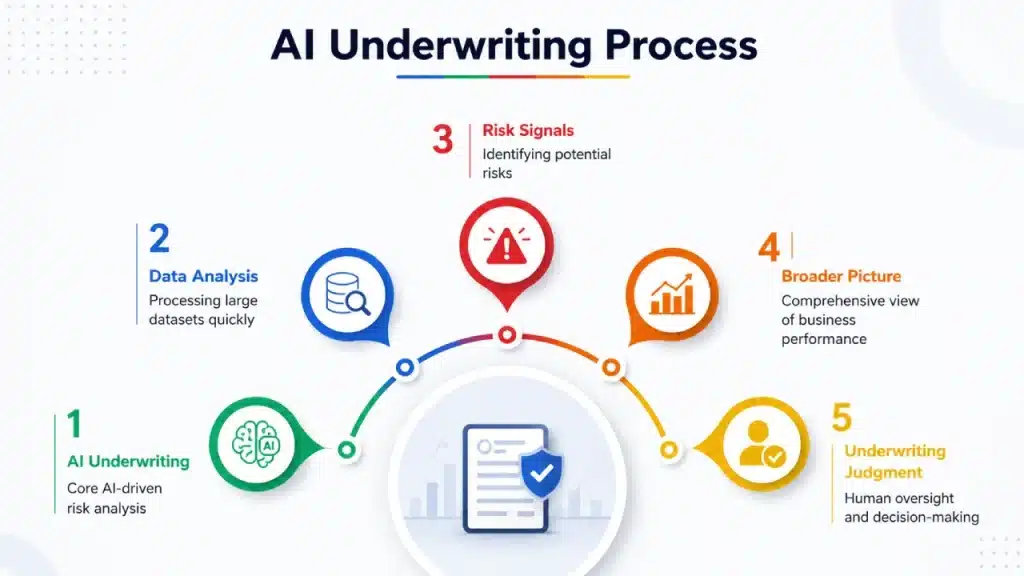
For example, if a Maryland restaurant has uneven monthly revenue because of weather, tourism, or local event traffic, an AI-assisted system may be better at recognizing recurring patterns instead of treating every fluctuation as a red flag.
If a home services company has strong deposits but inconsistent invoice timing, AI tools may help separate temporary cash-flow gaps from deeper repayment risk. This does not eliminate underwriting judgment. It improves the quality and speed of the information that underwriters and advisors can use.
Faster Decisions for Maryland business owners
One of the biggest changes AI brings to loan underwriting is speed. Borrowers increasingly expect quick answers, especially when they need capital for payroll, inventory, equipment, expansion, or an unexpected cash crunch. Many modern lenders now use technology to shorten intake, verify information faster, and surface approval paths sooner.
Committed to Capital itself positions its model around fast, flexible funding, same-day decisions, and personalized support rather than bank-style red tape.
That speed can be especially valuable for small businesses in Maryland’s competitive markets. A business owner may need to move quickly on a new lease in Silver Spring, replace essential equipment in Frederick, add staff for a busy season in Ocean City, or purchase inventory for a rush of demand in Prince George’s County. AI-assisted underwriting can help reduce delays by automating parts of document review, flagging incomplete files, and identifying which applications are likely to meet a lender’s criteria before a human team spends hours reviewing every line manually.
The practical result is not just convenience. It can mean fewer missed opportunities. In small business finance, timing often matters almost as much as the capital itself.
A Wider lens than traditional underwriting
Traditional small business underwriting often leaned heavily on a few narrow measures. Personal credit score, time in business, annual revenue, and existing debt obligations still matter, but AI systems can add context around those numbers. That broader view can be useful for borrowers whose businesses are strong but do not fit neat bank templates.
A Maryland business may have healthy revenue but a short operating history. Another may be profitable yet show irregular seasonal cash flow. A newer company may have strong deposits, repeat customers, and improve margins even if its tax returns do not yet tell the full growth story. AI models can help surface those strengths faster by recognizing patterns across datasets rather than relying on one static cutoff.
Need funding backed by speed, flexibility, and real business insight? Contact Committed to Capital today or apply now to explore smarter financing solutions tailored to your Maryland business goals.
This shift does not guarantee approval, and it does not remove risk standards. What it can do is reduce the chance that a business is misunderstood simply because its financial profile looks nontraditional.
Better Matching between borrower and funding product
AI is also changing underwriting by improving product fit. Small business funding is not one-size-fits-all. Term Loan, Line of credit, SBA-backed solution, Equipment financing option, or Revenue-based product may each serve a different business need. The best underwriting process is not just about deciding yes or no. It is about identifying what type of financing best matches the borrower’s cash flow, timeline, and repayment capacity.
That is where technology and human guidance work best together. AI can quickly organize and analyze the file. An experienced funding advisor can then interpret that information, explain tradeoffs, and help the business owner choose the structure that makes sense. This combined approach aligns closely with Committed to Capital’s stated focus on matching businesses with fast, flexible financing built around real cash flow, goals, and industry context.
The Compliance side is getting more important
As AI becomes more common in lending, transparency matters more, not less. The Consumer Financial Protection Bureau has emphasized that lenders using AI or other complex models still must provide specific reasons when taking adverse action. In other words, “the algorithm said no” is not good enough. Lenders need to be able to explain decisions in a meaningful way.
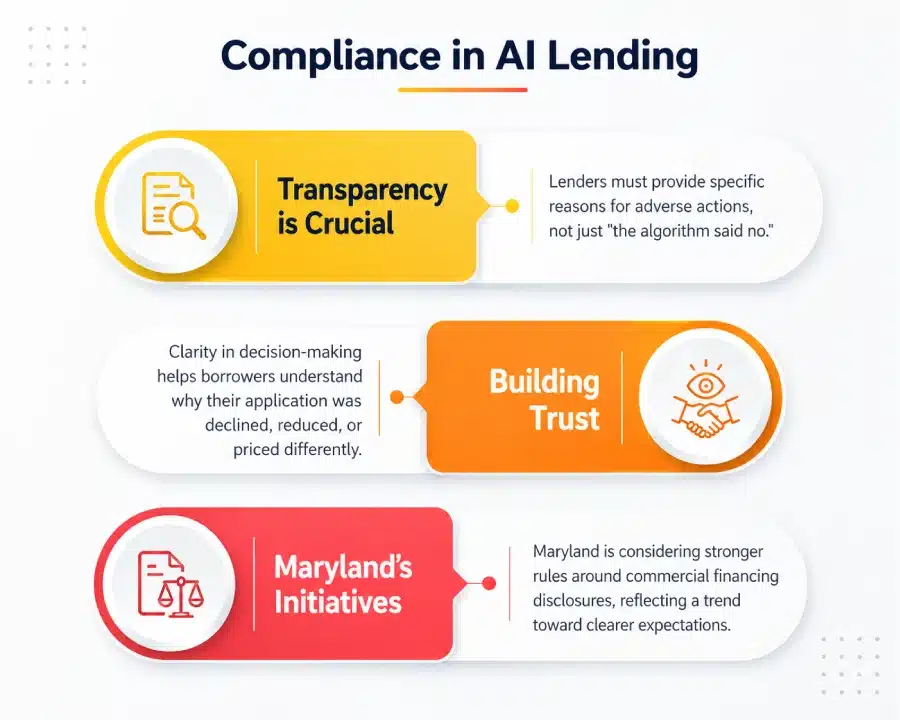
That principle is important for trust. Maryland business owners want speed, but they also want clarity. If an application is declined, reduced, or priced differently, the borrower should understand why. That makes it easier to improve future eligibility and helps prevent opaque decision-making from undermining confidence in the process.
Maryland is also actively considering stronger rules around commercial financing disclosures. In 2026, Senate Bill 881 advanced in the General Assembly and addressed licensing requirements and regulation of commercial financing, reflecting continued momentum toward clearer disclosures and more standardized expectations in the market.
The Real risks of AI underwriting
AI is powerful, but it is not automatically fair or accurate. It depends on the data it is trained on, the way the model is built, and the controls wrapped around it. If a lender uses poor-quality inputs, outdated assumptions, or overly aggressive automation, AI can reinforce bad decisions just as efficiently as it can improve good ones.
That is why risk management is a major part of the conversation. NIST’s AI Risk Management Framework and its later generative AI profile both focus on building trustworthy AI systems and managing risks such as bias, reliability, and governance. Those ideas are highly relevant in lending, where underwriting decisions directly affect access to capital.
For Maryland borrowers, the takeaway is simple: faster underwriting is valuable, but responsible underwriting is what really matters. The best lenders use technology to strengthen consistency and insight, while still keeping humans in the loop for review, judgment, and customer communication.
What this means for small businesses in Maryland right now
AI is making underwriting more data-driven, more responsive, and in many cases more borrower-friendly. Business owners who once felt boxed out by slow bank processes may now have more paths to review and more flexible ways to demonstrate creditworthiness. At the same time, lenders and funding partners have to balance innovation with explainability, fair treatment, and transparent disclosures.
That balance is especially important in a diverse business landscape like Maryland’s. From Baltimore and Columbia to Rockville, Bowie, Towson, and the Eastern Shore, small businesses operate in different industries, with different seasonality and growth patterns. A modern underwriting process should recognize that reality instead of forcing every borrower into the same template.
The future of small business lending in Maryland is not just about automation. It is about smarter decision-making. When AI is paired with experienced advisors, clear terms, and a real understanding of business cash flow, underwriting becomes more useful, more transparent, and more aligned with how entrepreneurs actually operate.
For business owners exploring financing, that is the real opportunity. AI is not replacing relationships in lending. It is giving good lenders better tools to understand borrowers faster and serve them more effectively.