Securing loan approval with bad credit may feel like climbing a steep hill, but it’s far from impossible. Many small and medium-sized business owners wonder will I be accepted with bad credit? and the honest answer is yes, more often than they expect. A low credit score, whether it stems from past financial mistakes, unexpected emergencies, medical bills, or simply a limited credit history, does not lock you out of funding. What it does mean is that you’ll need a smarter, more strategic approach to get approved for a loan with bad credit on terms that actually work for your business.
Key Takeaways
- Loan approval with bad credit is possible when lenders consider cash flow, collateral, and time in business, not just FICO scores.
- Secured loans, cosigners, and credit unions offer the highest approval odds when you’re trying to get approved for a loan with bad credit.
- Fixing credit report errors and reducing your debt-to-income ratio can quickly improve approval chances before applying.
- Alternatives like PALs, BNPL, and crowdfunding can bridge funding gaps without traditional loan requirements.
- Preparation matters — documentation, a growth plan, and a brief explanation of your credit history strengthen any application.
In this guide, we’ll walk through practical strategies, loan types, and alternative funding options so you can move forward confidently in 2026. Our goal is to help you understand not only how loan approval with bad credit actually works behind the scenes, but also how to position your business for long-term financial health. Think of the next few sections as a roadmap: first the why, then the how, and finally the backup plans if a traditional loan isn’t the right fit right now.
What Counts as Bad Credit for a Business Loan?
Bad credit is a credit profile that lenders view as higher-risk, typically a personal FICO score below 580 or a business credit score that shows late payments, defaults, or limited history. In practice, most lenders treat scores in the 300–579 range as “poor” and 580–669 as “fair.” Neither range disqualifies you automatically.
Here’s the part borrowers often miss: business lending rarely relies on a single number. When you apply for loans for bad credit, an underwriter is really asking one question — can this business realistically repay? Your score is one input, but revenue, deposits, and collateral frequently carry more weight. That’s exactly why loan approval for bad credit is achievable even when a personal score looks discouraging.
Why Loan Approval With Bad Credit Is Still Possible
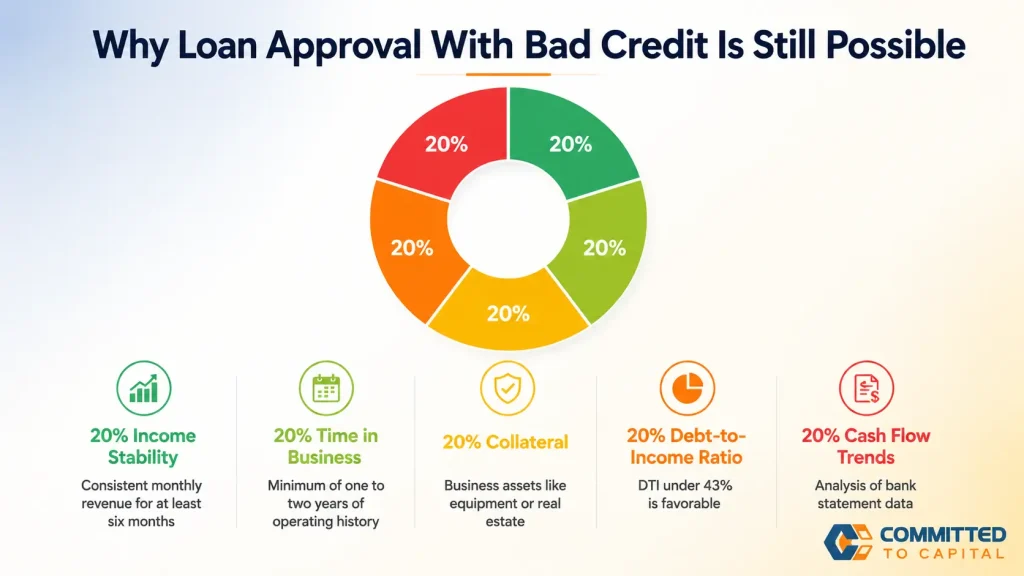
Banks and lenders look at far more than just a three-digit credit score. While a high score makes the process smoother, modern underwriters especially alternative lenders weigh several other factors that can tip the decision in your favor:
- Income stability – Is your business generating consistent monthly revenue? Lenders often want to see at least six months of steady deposits.
- Time in business – Many bad-credit lenders require a minimum of one to two years of operating history as proof of viability.
- Collateral – Do you have business equipment, inventory, real estate, or receivables that can secure the loan?
- Debt-to-income (DTI) ratio – How much existing debt are you carrying relative to revenue? A DTI under 43% is generally viewed favorably.
- Cash flow trends – Lenders increasingly rely on bank statement analysis rather than FICO scores alone.
Consider a simple example. A landscaping company with a 560 owner credit score but $40,000 in steady monthly deposits and two years of operating history is often a stronger candidate than a brand-new business with a 700 score and no revenue track record. The first business has proven it can generate cash; the second has only proven it can borrow responsibly in the past. That shift in how lenders evaluate risk is precisely why so many owners successfully get approved for a loan with bad credit.
The reality is that loan approval with bad credit often comes with higher interest rates, shorter repayment terms, or stricter covenants. However, by demonstrating stability, responsibility, and preparedness, you can still secure the capital your business needs — and refinance into better terms once your profile improves.
How to Get Approved for a Loan With Bad Credit: 6 Proven Strategies
If you’re asking how can I get approved for a loan with bad credit?, the short answer is to reduce the lender’s perceived risk. Here are six proven strategies you can apply starting today.
1. Find Lenders Who Specialize in Bad Credit
Not all lenders are the same. Community banks, online fintech lenders, and credit unions often provide more flexible options than traditional big banks. Credit unions in particular tend to have a community-first approach and lower credit thresholds, making loan approval with bad credit far more realistic. Because credit unions are member-owned nonprofits, they’re often willing to look past a rough patch and focus on your overall relationship and revenue.
Online lenders like fintech platforms can also approve applicants in as little as 24 hours by using automated underwriting that weighs cash flow over credit score. The practical takeaway: don’t waste a hard inquiry on a national bank with rigid cutoffs when a specialized lender is far more likely to say yes. Matching your profile to the right lender is the single biggest factor in how to get accepted for a loan with bad credit.
2. Apply With a Cosigner or Co-Borrower
If you can bring someone with strong credit to back your application, your odds improve dramatically. A cosigner shares legal responsibility for repayment, which reduces risk for the lender and can also lower your interest rate by several percentage points. This is one of the fastest routes to loan approval for bad credit because it effectively “borrows” the cosigner’s creditworthiness.
Just be clear-eyed about the stakes. Make sure both parties understand — in writing — that a missed payment affects both credit profiles. A cosigner arrangement is a genuine financial commitment, not a formality, so choose someone who understands the obligation and whom you can keep informed about the loan’s status.
3. Choose Secured Loans
Secured loans require you to pledge collateral such as business equipment, commercial real estate, accounts receivable, or savings accounts. Because the lender has a tangible asset to recover if you default, they’re far more likely to approve your request even with a credit score in the 500s. This is often the most dependable way to get a loan approved with bad credit.
Common secured options include:
- Equipment financing – The equipment itself serves as collateral, so approval hinges on the asset’s value.
- Invoice factoring – You sell unpaid invoices for immediate cash; your customers’ creditworthiness matters more than yours.
- Asset-based lines of credit – Borrow against inventory or receivables and draw funds as you need them.
The trade-off is real: if you can’t repay, you can lose the pledged asset. Weigh that risk honestly against the working capital you’ll gain.
4. FHA Loans
If you’re seeking a mortgage or commercial property loan, FHA-backed loans may work in your favor. With flexible requirements, they sometimes accept scores as low as 580 with a 3.5% down payment, or as low as 500 with 10% down. FHA loans are government-insured, which is why lenders can extend approval to borrowers who would be turned away from conventional mortgages — a useful path for owner-occupied properties that double as business premises.
5. Home Equity Loans or HELOCs
If you own property, tapping into your home equity is another way to get financing. This is a secured option, and lenders are often more willing to grant loan approval with bad credit when home equity is involved. Because your home backs the loan, rates are usually lower than unsecured bad-credit products.
That said, weigh the risk of pledging your residence carefully. A HELOC (home equity line of credit) turns your house into collateral, so a serious repayment problem could put your home at risk. Use this option when you have a clear, high-confidence plan to repay.
6. Merchant Cash Advances
For businesses with steady credit card sales, a merchant cash advance provides upfront capital in exchange for a percentage of future sales. Approval rests almost entirely on revenue, not credit score — making it one of the more accessible loans for bad credit borrowers with strong daily sales. Retailers, restaurants, and salons often qualify quickly here.
The catch is cost. Factor rates can be steep, and because repayment is tied to a slice of daily revenue, cash flow can tighten during slow periods. Read the terms carefully, calculate the true annualized cost, and treat a merchant cash advance as a short-term bridge rather than a long-term solution.
Alternatives to Loans for Bad Credit Borrowers
Sometimes the best option isn’t a traditional loan at all. If you’ve been repeatedly asking how can I get approved for a loan with bad credit and hitting walls, these alternatives are worth exploring:
- Secured Credit Cards – These help rebuild your score while providing small amounts of working capital. Most require a refundable deposit equal to your credit limit, and on-time payments are reported to the bureaus.
- Borrowing From Friends or Family – With clear written terms and a repayment schedule, this can be the most flexible and affordable option available. Put the agreement in writing to protect the relationship.
- Payday Alternative Loans (PALs) – Offered by federal credit unions, PALs are capped at 28% APR, far safer and cheaper than predatory payday loans that can exceed 300%.
- Buy Now, Pay Later (BNPL) – For smaller purchases, BNPL services let you split payments into installments without large upfront costs or hard credit checks.
- Cash Advance Apps – Useful for immediate, short-term needs, though they may charge small subscription or expedite fees.
- Crowdfunding – Platforms like Kickstarter, GoFundMe, or Kiva let you raise capital from supporters without affecting your credit at all. Kiva, in particular, offers 0% interest microloans to small businesses.
Each of these paths sidesteps the strict credit thresholds that make traditional approval difficult, giving you room to fund operations and rebuild your credit at the same time.
How to Improve Your Credit Before You Apply
A little preparation on your credit report can meaningfully raise your approval odds and lower your rate. Before you submit an application, take these steps:
- Pull all three credit reports and dispute any errors, outdated balances, accounts that aren’t yours, or paid debts still marked open.
- Pay down revolving balances to reduce your credit utilization ratio, which is one of the fastest levers you can pull.
- Reduce your debt-to-income ratio by clearing small balances or increasing documented revenue before applying.
- Keep older accounts open to preserve the length of your credit history.
- Avoid opening new accounts in the 90 days before you apply for loans with bad credit.
Even a 20-to-40-point improvement can move you into a lower-risk tier and unlock better terms so this step often pays for itself.
Expert Tips to Strengthen Your Application
Before submitting any application, prepare like a lender will read it twice:
- Prepare Documentation – Two years of tax returns, six months of bank statements, recent invoices, and proof of revenue help show you’re financially organized and responsible.
- Write a Brief Explanation Letter – Many lenders will listen if you can explain why your credit dipped (a medical event, divorce, or business downturn) and what you’ve done since to recover. A one-paragraph “letter of explanation” reframes a low score as a temporary setback rather than a pattern.
- Highlight Your Business Growth Plan – Showing a realistic roadmap for revenue growth gives lenders confidence in your future ability to repay.
- Work With a Financial Advisor or Broker – Expert guidance can match you with lenders who specifically work with loan approval for bad credit applicants, saving you the credit-pull damage of multiple denied applications.
- Avoid Multiple Hard Inquiries – Each formal application can drop your score by 5–10 points. Apply only to lenders whose minimum requirements you actually meet.
Why Business Owners Choose Committed to Capital for Bad-Credit Financing
When traditional banks say no, Committed to Capital says let’s find a way. We’ve built our reputation on three core values: Commitment, Trust & Transparency, and Care — and it shows in every funding decision we make.
From working capital and lines of credit to merchant cash advances and SBA-backed options, our financing solutions are designed for real businesses facing real credit challenges. No hidden fees. No confusing terms. Just honest funding from a team that treats your business like it’s our own. Whether you need to cover payroll, buy equipment, or smooth out seasonal cash flow, we help you get approved for a loan with bad credit without the runaround.
Apply Online in Minutes and let’s get your business moving forward.
Final Thoughts
Getting loan approval with bad credit isn’t easy, but it’s far from impossible in 2026. By understanding your options, improving your financial profile, and targeting lenders who specialize in working with borrowers like you, you can secure the capital needed to move your business forward.
Every step you take reducing debt, fixing report errors, pledging collateral, or starting with a smaller loan moves you closer to approval and to better terms next time around. Remember: your credit score is just one part of your story. Show lenders you’re committed to repaying responsibly, and opportunities will open up.